
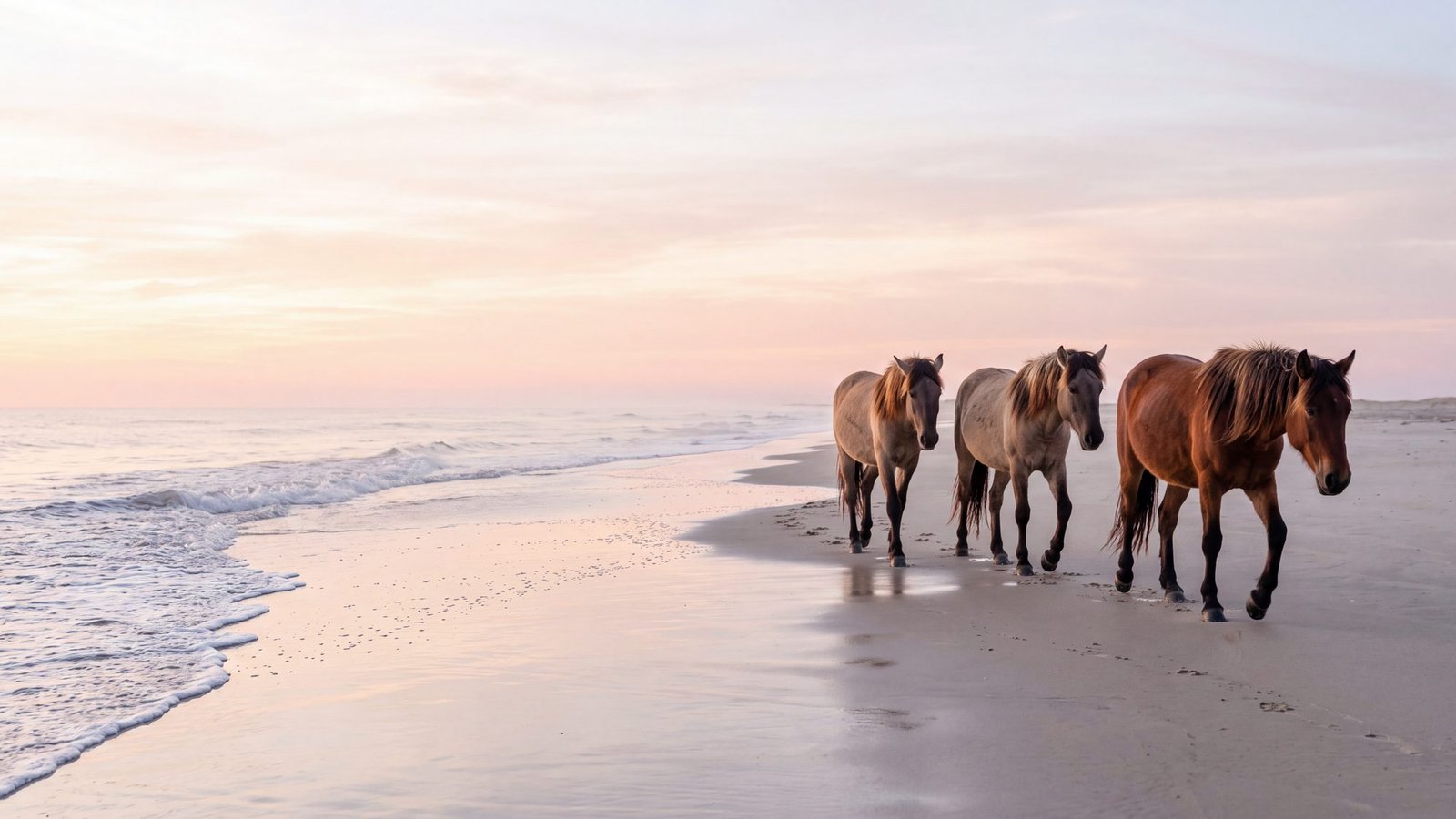
The Corolla wild horses are the main reason a lot of people point a 4x4 north of the pavement. Here’s what’s actually true about where they are, how the guided wild horse tours work, how to see the horses without one, and the laws that keep both you and the horses out of trouble. Most wild-horse content online is written by the companies selling the tours; this isn’t, so we’ll tell you where the trade-offs really are.
Spending the day up here? The Corolla Wild Goose Chase is a self-guided hunt you play on your phone in Corolla, and The End of the Road runs the 4x4 beach north to the Virginia line. Off-Roading with Fido runs that same sand with the dog along. All three are $29 a team.
Quick orientation before the details: the horses live on a stretch of beach north of Corolla that you reach only by four-wheel drive, they’re protected by county law you can actually be fined under, and they’re a genuinely rare breed rather than feral strays. Everything below is built around those three facts — where to go, what not to do, and how to decide between a tour and driving yourself.
Where the horses actually are
First myth to kill: the horses do not live in Corolla proper. If you drive to the shops and the lighthouse in Historic Corolla, you will not find a herd wandering the parking lots. The horses live north of where the NC-12 pavement ends, in the 4x4-only area — the string of communities called Swan Beach, North Swan Beach, and Carova — running all the way up to the fence at the Virginia state line.
They’re kept in place by sound-to-sea fences at both ends: a fence at the end of the pavement to the south, and a fence at the Virginia line to the north. Between them sits a sanctuary of about 7,544 acres — roughly one-third public land and two-thirds private. The beach that runs through it is legally a public road, which is why you can drive it, but the land behind the dunes is a mix of homes and protected habitat.
Set your expectations before you go: sightings are common but never guaranteed. The horses move between the open beach and the shaded interior sand roads depending on heat, biting flies, and the season. Some days you’ll pass a harem grazing near the dunes within ten minutes; other days you’ll drive the whole beach and see them only well inland. Anyone promising a guaranteed sighting is selling something.
Practically, that means the trip is a commitment. From the end of the pavement it’s several miles of soft beach and sand roads to reach the heart of the horse country around North Swan Beach and Carova, and there are no services once you’re past the ramp — no gas, no stores, no cell certainty. That remoteness is exactly why the herd survives here, and it’s why the sanctuary is fenced off at both the pavement’s end and the Virginia line rather than left open to traffic.
The horses live in Carova, the 4x4-only stretch north of Corolla. What that place is, how you get in and the rules are in the Carova Beach visitor guide.
Map of the wild horse area
Save this map to your phone for offline use
The map covers the 4x4 zone the horses live in: the 4x4 ramp and air-down area east of Corolla Village Road where the pavement ends, the sanctuary boundaries (south fence at the end of the pavement, north fence at the Virginia line), the communities of Swan Beach, North Swan Beach, and Carova inside the horse area, the Corolla Wild Horse Fund museum in Historic Corolla, and Currituck Beach Lighthouse as an orientation landmark. We deliberately don’t pin “current horse locations” — the herd moves every day, so a pin would only lie to you.
Use the map to get your bearings before you leave pavement, because once you’re on the sand the landmarks thin out fast. The single most important spot is the ramp and air-down area east of Corolla Village Road — that’s where the pavement ends, where you drop your tire pressure, and where the fenced sanctuary begins. From there north, everything is horse country until the Virginia line fence.
The rules (and they’re actual laws)
These aren’t polite suggestions. Under the Currituck County Wild Horse Ordinance, it is illegal to intentionally come within 50 feet of a wild horse. It is also illegal to feed or lure them, and the fines are substantial. If a horse walks toward you, you’re expected to back away and keep the 50 feet — the distance is on you, not the horse.
The feeding ban isn’t sentimental — it’s about keeping the horses alive. They live on a specialized diet of sea oats, coarse native grasses, acorns, and persimmons. Human food they aren’t built to digest, including apples and carrots, can cause colic that is sometimes fatal. So don’t hand-feed, don’t leave food out, and secure your trash so they can’t get into it.
If you find a horse that’s injured or entangled, don’t approach it. Report it to the Corolla Wild Horse Fund at 252-453-8002, or to Currituck County dispatch and let the people trained to handle a half-ton wild animal do their job.
The 50-foot rule catches a lot of visitors off guard because the horses don’t respect it — they’ll walk right up to a parked vehicle or graze beside the road. That’s still your responsibility to manage: turn off the engine, stay in or beside your vehicle, and let the horse pass rather than positioning yourself for a closer photo. A phone zoom or a small telephoto lens gets you the shot without breaking the law or stressing an animal that has to live here after you leave.
It’s worth being blunt about why the feeding ban is enforced so hard: a horse that learns to associate people and vehicles with food starts approaching them, which leads to road strikes, aggressive behavior, and animals that have to be managed or removed. Feeding a wild horse feels kind in the moment and is one of the most damaging things a visitor can do.
Corolla wild horse tours vs. driving up yourself
Both ways work, and both have real downsides. Pick based on whether you’d rather have a guide do the finding or have your whole day on your own clock.
Our beach-driving site has a longer tours-versus-driving-yourself comparison with costs, what you see on each, and who each option suits.
Guided tours. The guides know where the harems have been hanging out lately, you don’t need your own vehicle, and a typical trip runs about two hours. The downside is the schedule: it’s a shared vehicle on a fixed departure, and you leave when the tour leaves — not when you’re done watching.
Driving yourself. You go on your own clock and can fold the horses into a full beach day instead of a two-hour ride. You’ve got air conditioning in August, heat in January, windows that go up when the wind is throwing sand, and the dog comes along; most tour vehicles are open-air and shared. You’ll need a true 4WD vehicle — not an AWD crossover — and you air down to 18–20 psi at the air-down area east of Corolla Village Road before you hit the sand. The downside is simple: there’s no guide, so you find the horses yourself, or you don’t. If you don’t own the right vehicle, you can rent a permitted 4x4 from Beach4x4, our 4WD rental company in Kill Devil Hills, which includes the county beach parking permit and runs 7 AM–8 PM, 7 days a week.
Parking reality. There is no permit required to drive the beach. But a Currituck County beach parking permit is required to park on the sand in season — for 2026 that runs May 9 through September 26, at $50 per week, capped at 300 permits per week, sold online only, on sale since April 1. County residents and property owners use their Access Permit instead. If you’re renting, the permit comes included with the rental.
One more real trade-off between the two options: a tour is the better call if you’re not confident driving a heavy vehicle in soft sand, if you’re only in the area for a short window, or if you’d rather not deal with airing down and back up. Driving yourself wins if you want a full beach day, you’re comfortable with 4WD, you’re bringing the dog, or you’d rather watch the horses from a warm (or cool) 4x4 with the windows up than from an open tour truck. Neither is the “right” answer — they’re just different days.
One more pre-drive check: the beach narrows fast on a rising tide — see the Carova tide chart before you head up.
Who these horses are
These are Colonial Spanish Mustangs — the strain often called Banker horses. That’s not marketing: DNA testing in 1992 and again in 2007 by Dr. Gus Cothran at Texas A&M confirmed their Spanish origin. They’re one of the oldest and rarest horse strains anywhere, and the breed carries a critically endangered listing.
They’ve been here roughly 500 years, descended from 16th-century Spanish stock. How they first arrived is genuinely unsettled: one theory is shipwreck, another is deliberate abandonment by early explorers. Both are legitimate, and anyone who tells you it’s definitely one or the other is guessing. They’re also the official State Horse of North Carolina.
The herd today is a little over 100 animals and holding steady, according to the Corolla Wild Horse Fund. These are small horses — about 12 to 14 hands — and they travel in harems, typically one stallion with one to four mares.
The reason there’s still a herd to see: the Corolla Wild Horse Fund (CWHF) formed in 1989 after horses were being killed on the newly paved NC-12. The herd was relocated behind the sound-to-sea fences, a move completed in 1996–97. CWHF is the authority here, and they run a museum in Historic Corolla worth a stop. If you want to learn more or help, give your support — and any donations — to the Corolla Wild Horse Fund.
The harem structure is part of what makes a sighting interesting once you understand it. A band is led by a single stallion with his mares and their young, and bachelor stallions travel separately until they can win or start a harem of their own. When you see two groups keeping their distance on the beach, that spacing is deliberate herd behavior, not chance.
The critically endangered status is the reason all of this matters beyond a nice photo. With a little over 100 animals, this is a small, genetically distinct population, and every horse lost to a preventable cause — a car, bad food, a fence cut — is a real dent in one of the oldest surviving strains of Colonial Spanish horse in the country. The Corolla Wild Horse Fund manages the herd’s health, tracks the population, and handles rescues, which is why they’re the group to support rather than any tour operator.
Odds of seeing them
The horses are on the sanctuary year-round, so there’s no closed season for looking. Winter is quietly a good time to go: far fewer people on the beach, and the horses are still there. Whenever you go, treat a sighting as likely but not promised. We won’t tell you a sighting is guaranteed, because it isn’t — and anyone who does is telling you what you want to hear rather than what’s true.
A few practical odds-improvers that don’t overpromise: give yourself hours, not minutes, because the more beach and sand road you cover the better your chances, and don’t blow past the interior roads, since the shade there is often where the horses actually are when the beach looks empty. None of that guarantees anything — it just stacks the deck slightly in your favor.
FAQ
Locally verified
Reviewed by the Beach4x4 team in Kill Devil Hills, NC
Last checked: September 2026
Sources: the official park, town and county pages for this topic. Always confirm hours, fees, and closures with the official source before you go.
Can you see the Corolla wild horses without a tour?
Yes. The horses live on a public beach you can legally drive, so you can find them yourself if you have a true 4WD vehicle and air down at the ramp east of Corolla Village Road. A guided tour trades your own schedule for a guide who knows where the harems have been lately — handy, but not required.
Where exactly do the wild horses live?
North of where the NC-12 pavement ends, in the 4x4-only area — Swan Beach, North Swan Beach, and Carova — up to the Virginia state line. They are fenced into a roughly 7,544-acre sanctuary and are not found in Corolla proper.
Is it illegal to touch or feed the wild horses?
Yes. The Currituck County Wild Horse Ordinance makes it illegal to intentionally come within 50 feet of a horse or to feed or lure them, and violations carry substantial fines. Human food like apples and carrots can cause fatal colic, which is why the feeding ban exists.
Do you need a permit to see the horses?
No permit is required to drive the beach. However, a Currituck County beach parking permit is required to park on the sand in season — for 2026 that runs May 9 through September 26, at $50 per week, capped at 300 per week, sold online only. County residents and property owners use their Access Permit instead.
How many Corolla wild horses are there?
A little over 100, and holding steady, according to the Corolla Wild Horse Fund. They are small horses of about 12 to 14 hands that travel in harems of one stallion and one to four mares.
Are they really wild?
Yes. They are free-roaming Colonial Spanish Mustangs — Banker horses — whose Spanish origin was DNA-confirmed in 1992 and 2007. They have lived here for roughly 500 years and are the official State Horse of North Carolina.