
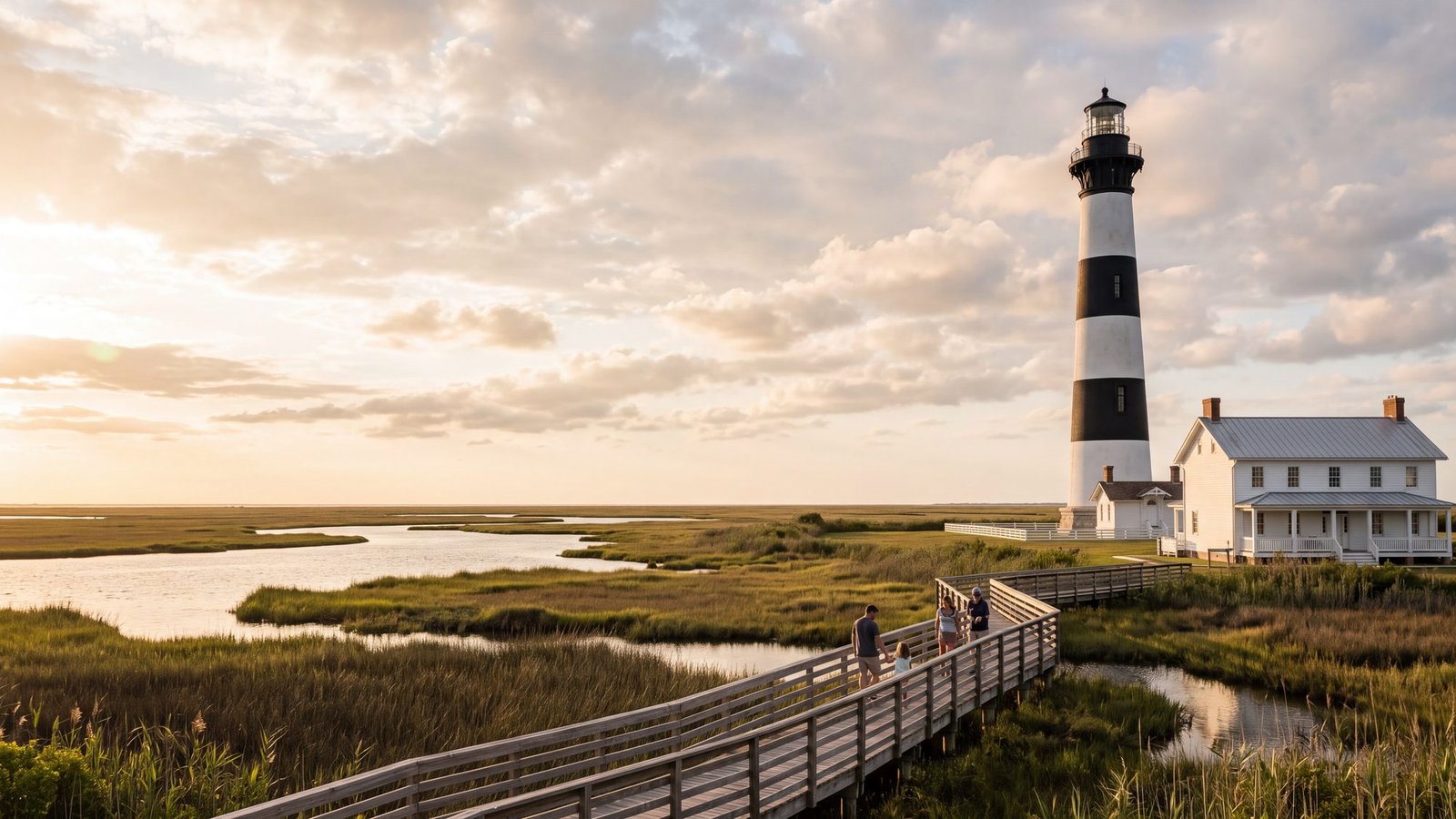
The Outer Banks has five historic lighthouses, strung along more than a hundred miles of barrier island from Corolla down to Ocracoke. They are the most photographed things on this coast and the most misunderstood: the stripes are not decoration. Each tower is painted differently on purpose, so a ship could tell one from another in daylight, when no light is burning.
This guide maps all five, gives you the real numbers for each, explains the paint, and sorts out which ones you can actually climb this year — including where the Cape Hatteras restoration currently stands.
Map of the Outer Banks Lighthouses
Save this map to your phone for offline use — signal drops on the drive south of Rodanthe and again on the Ocracoke ferry.
Why they are painted differently: the daymark
A daymark is the pattern painted on a lighthouse so it can be identified in daylight. At night a tower is known by its flash — how long the light shows and how long it stays dark. In daylight there is no flash to read, just a tall pale shape on a low sandy shore, and one of those looks much like another from a few miles out at sea. So each tower was given a pattern no neighbor shared.
| Lighthouse | Daymark | Where |
|---|---|---|
| Currituck Beach | Bare red brick, unpainted | Corolla |
| Bodie Island | Two wide black bands on white | Nags Head, near Oregon Inlet |
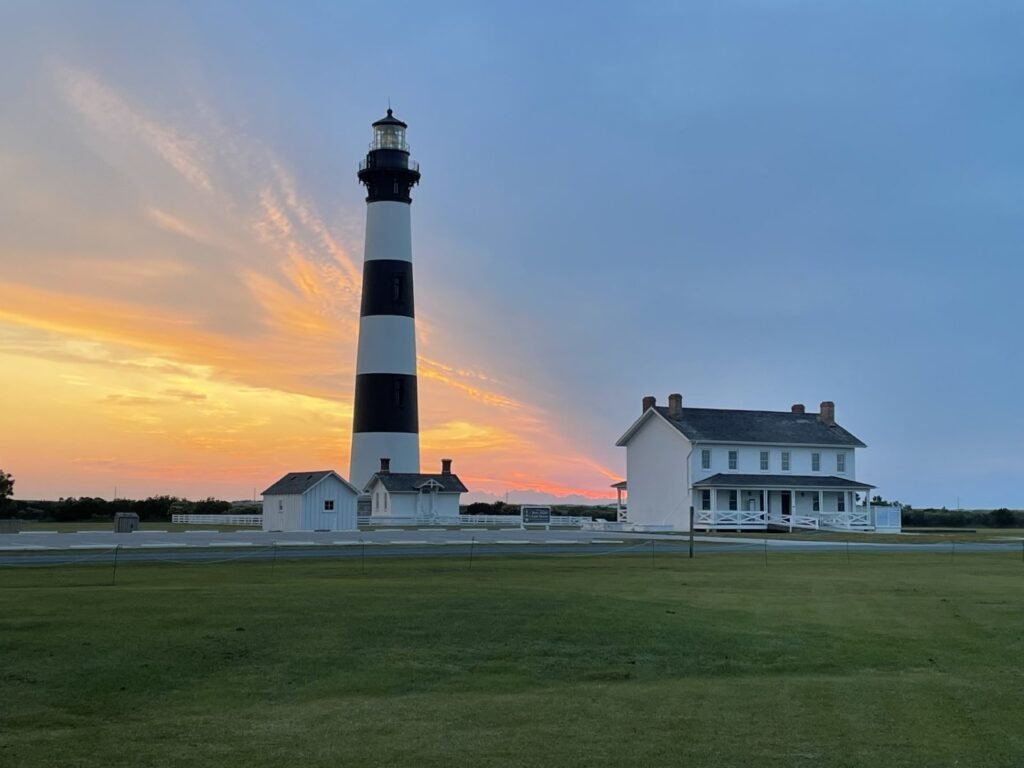
| Cape Hatteras | Black-and-white spiral — four bands, two black and two white, each making one and a half turns around the tower | Buxton |
| Ocracoke | Plain white, top to bottom | Ocracoke village |
| Roanoke Marshes | White cottage on a pier — a shape rather than a pattern | Manteo waterfront |
The pattern is the identity. A mariner reading a chart looked for the paint first and the flash after dark.
The Lighthouse Board painted the North Carolina coast in 1873, giving Cape Hatteras its spiral and Cape Lookout, further south, its diamonds. When Currituck Beach was finished two years later the useful patterns nearby were already taken — so it was deliberately left unpainted. On that tower the bare brick is the daymark, and it is the only one on the coast wearing none.
There is a tidy story that the Hatteras and Lookout patterns were swapped by mistake, since Cape Hatteras is the one guarding Diamond Shoals. It is not true, and there is no evidence for it. The patterns were chosen to be unlike each other, not to describe the hazard.
Outer Banks lighthouses at a glance
| Lighthouse | First lit | Height | Steps | Climb? | Town |
|---|---|---|---|---|---|
| Currituck Beach | 1875 | 162 ft | 220 | Yes, in season | Corolla |
| Bodie Island | 1872 | 156 ft | 219 | Yes, April–October | Nags Head |
| Cape Hatteras | 1871 | 210 ft | 257 | Closed until summer 2027 | Buxton |
| Ocracoke | 1823 | 75 ft | — | No, never open | Ocracoke |
| Roanoke Marshes | 2004 replica | One and a half storys | — | No, but you can walk in | Manteo |
Heights are of the tower itself. Cape Hatteras is the tallest brick lighthouse in the United States; Ocracoke is the oldest still operating in North Carolina.
The five Outer Banks lighthouses
Currituck Beach Lighthouse (Corolla)
The northernmost of the five and the last big brick lighthouse built on the Outer Banks. First lit on 1 December 1875, it stands 162 feet, took roughly a million bricks, and still carries its original first-order Fresnel lens — the largest size ever made. Its light shows for three seconds, then goes dark for seventeen, and can be seen 18 nautical miles out.
It is the one tower here that was never painted, and that was the point (see the daymark above). The Outer Banks Conservationists have held the deed since 2003 and run the climb: 220 steps to the gallery, and from the top you look down on Currituck Sound on one side and the 4x4 beach where the wild horses run on the other.
Visiting: the 2026 season runs 21 March to 30 November, daily 9 a.m. to 5 p.m., weather permitting. The climb is $13 for ages 4 and up; under-4s go up free in a carrier. The grounds, the museum shop and the parking are free — you can walk right up to the base and photograph it without buying anything. It sits in Historic Corolla Park beside the Whalehead house, so it pairs naturally with the rest of Corolla.
Bodie Island Lighthouse (Nags Head)
Two black bands on white, standing in the marsh just north of Oregon Inlet. This is the third lighthouse on this spot. The first, built in 1847, was abandoned on a bad foundation and leaned. The second, finished in 1859, was blown up in 1861 by retreating Confederate troops who did not want the Union using it as a lookout. The one you see was first lit on 1 October 1872, stands 156 feet, and has a first-order Fresnel lens.
After dark its flash is worth timing: two and a half seconds on, two and a half off, two and a half on, then about twenty-two seconds of dark — twice a minute, every night. That rhythm is the tower’s night-time name, the same way the bands are its daytime one.
Visiting: the National Park Service runs it. 219 steps to the top, climbs April to October. Tickets are same-day only on recreation.gov, released at 7 a.m. for that day — there is no walk-up window. $10 for adults, $5 for seniors 62 and over and for children under 12, who must be taller than 42 inches to climb. The grounds, the keepers’ quarters visitor center and the marsh boardwalk are free, and the boardwalk is the best photograph on the property.
Cape Hatteras Lighthouse (Buxton)
The tallest brick lighthouse in the United States at 210 feet, and the most recognisable structure on the North Carolina coast. The tower you see is the second on this cape — a sandstone light stood here from 1802 and was too short and too dim for the job. The current one was built in 1870, first lit on 16 December 1871, took about 1,250,000 bricks, and got its spiral in 1873.
In 1999 the sea had come within 15 feet of it. Rather than lose it, the whole 210-foot tower was jacked up and rolled 2,900 feet inland to the southwest, which remains one of the largest structures ever moved intact. It now sits about 1,500 feet from the water. The circle of granite stones marking the original site was itself moved off the beach in 2015 — the spot where it stood for 129 years is now just open sand.
Visiting: see the restoration section below. The climb is 257 steps when it is open, which it is not at the moment.

Ocracoke Lighthouse (Ocracoke Island)
Short, white and the oldest of the lot: built in 1823 and the oldest light station still operating in North Carolina. It is only 75 feet tall, which is unusual here — it was never meant to warn ships off a cape miles out to sea, only to guide them through Ocracoke Inlet. An earlier light had stood about a mile away since 1795. Its fourth-order Fresnel lens went in in 1854 and is still there.
Visiting: you cannot climb it, and never could as a visitor — the spiral stair inside is a simple steel one, rated for maintenance rather than crowds. In summer, when a ranger is on duty, you can go as far as the base. It stands in the village among the live oaks, a short walk from Silver Lake harbor, and the island is reachable only by ferry — which makes it the one light you have to plan a day around rather than drive past.

Roanoke Marshes Lighthouse (Manteo)
The odd one out, and the easiest to visit. This is a screw-pile lighthouse — a cottage on legs, screwed down into soft sound mud because there is nothing solid out there to build on. Sound lights looked like this, not like the tall coastal towers. The one on the Manteo waterfront is a replica, dedicated in 2004, standing on a pier at the end of the boardwalk.
The original was built in 1877 at the south end of Croatan Sound, on a site that had carried a light since 1857. It was decommissioned in 1955 and sold to a private buyer, who tried to move it by barge. It went overboard in rough water and was destroyed — which is why the coast has a copy rather than the real thing. The lens inside the replica, though, is genuine: a fourth-order Fresnel on loan from the Coast Guard, and it is lit every night.
Visiting: free, open daily 9 a.m. to 5 p.m., year round, across from the town-owned Roanoke Island Maritime Museum. No season, no ticket, no climb — you walk in. Easy to fold into a day in Manteo.
Which Outer Banks lighthouses can you climb?
| Lighthouse | Climb | Season | Tickets | Cost |
|---|---|---|---|---|
| Currituck Beach | 220 steps | 21 Mar – 30 Nov, 9–5 daily | At the door | $13, ages 4+ |
| Bodie Island | 219 steps | April – October | recreation.gov, same day only, from 7 a.m. | $10 adult / $5 senior 62+ and child under 12 (must be over 42 in tall) |
| Cape Hatteras | 257 steps | Closed until summer 2027 | — | — |
| Ocracoke | No public climb | Base accessible in summer when a ranger is on duty | — | Free |
| Roanoke Marshes | Walk in at ground level | Daily 9–5, year round | — | Free |
Seasons, hours and prices change year to year and close in bad weather — check before you drive. Every one of the five is free to walk up to and photograph; only the two climbs cost anything.
Cape Hatteras Lighthouse restoration: what is open right now
Cape Hatteras has been closed to climbing since 2020, and the current restoration has run longer than planned. Contractors opening up the gallery deck expected 30 to 40 cracked support brackets and found 116 — cast iron, load-bearing, hidden under brick, all needing replacement in stainless steel. That pushed the budget from about $19.2 million to roughly $30 million and the reopening from summer 2026 to summer 2027.
What has been done so far: the paint stripped inside and out, the brickwork repointed throughout, a replica Fresnel lens built, new fencing and paths, and native planting around the base. As of July 2026 the crews were repainting the daymark itself — putting the black-and-white spiral back on.
The grounds are the reason to still go. The site, the Museum of the Sea in the old keepers’ quarters and the park store stay open, and a scaffolded tower with its paint off is something no visitor will see again once the work is finished.
Planning a lighthouse road trip
Seeing all five in one day is a stretch and not much fun. Currituck Beach to Ocracoke is over a hundred miles of two-lane road plus a ferry crossing each way, and the ferry does not care about your schedule. Almost everyone is better off splitting it.
The northern pair — Currituck Beach and Bodie Island — is about an hour apart and makes a comfortable half day, with Manteo and the Roanoke Marshes light a short hop west if you want a third. Both northern towers are climbable, so this is the pairing to pick if getting to the top is the point.
The southern run — Cape Hatteras and Ocracoke — is a full day and a proper expedition: the drive down NC-12 past Rodanthe, then the Hatteras–Ocracoke ferry (free through 2026), which takes about 70 minutes each way and runs first come, first served. Get in the line early in summer. Neither of these two can be climbed at the moment, so this route is about the drive and the islands rather than the view from a gallery.
A few things worth knowing whichever way you go. Wear real shoes for a climb — the stairs are steep, open metal and there is no lift. The towers are hot inside in July. Morning light is kindest on Bodie Island and Currituck; evening suits Ocracoke and Manteo — our sunrise and sunset times will get you there at the right hour, and today’s conditions will tell you whether it is worth the drive at all.
The sixth light: Cape Lookout
Cape Lookout is not on the Outer Banks — it is about sixty miles further south on the Crystal Coast, reachable only by passenger ferry — but it finishes the story the paint started. Painted in the same 1873 program, it wears black and white diamonds, and they are not arbitrary: the black diamonds point north and south, the white ones east and west. Stand in front of it and the daymark tells you which way you are facing. It is the clearest surviving proof that the paint on these towers was information, not decoration.
Frequently asked questions
How many lighthouses are on the Outer Banks?
Five: Currituck Beach in Corolla, Bodie Island near Nags Head, Cape Hatteras at Buxton, Ocracoke in Ocracoke village, and the Roanoke Marshes replica on the Manteo waterfront.
Which Outer Banks lighthouse is the tallest?
Cape Hatteras, at 210 feet — the tallest brick lighthouse in the United States. Currituck Beach is next at 162 feet, then Bodie Island at 156. Ocracoke is the shortest of the towers at 75 feet.
Which is the oldest?
Ocracoke, built in 1823, and the oldest light station still operating in North Carolina. An earlier light stood about a mile away from 1795.
Why is the Currituck Beach Lighthouse not painted?
Because by 1875 the patterns around it were taken. The bare red brick was chosen deliberately as its daymark, so it could not be confused with the banded tower at Bodie Island or the spiral at Cape Hatteras. It is the only unpainted lighthouse on the Outer Banks.
Can you climb the Cape Hatteras Lighthouse?
Not at the moment. It has been closed to climbing since 2020 and is expected to reopen in summer 2027. The grounds, the Museum of the Sea and the park store remain open while the restoration continues.
Can you climb the Ocracoke Lighthouse?
No. The stair inside is a simple steel spiral rated for maintenance access only, and it has never been open to visitors. You can reach the base in summer when a ranger is on duty.
Which Outer Banks lighthouse can I climb this year?
Currituck Beach in Corolla and Bodie Island near Nags Head. Currituck sells tickets at the door through its 21 March to 30 November season; Bodie Island is April to October and same-day only on recreation.gov, released at 7 a.m.
Is it free to visit the Outer Banks lighthouses?
Yes, to look at them. The grounds and parking at all five are free, including Currituck’s. Only the two climbs cost anything, and the Roanoke Marshes light in Manteo is free to walk into.
Related OBX guides
Make a day of it: pair a lighthouse trip with our Outer Banks beaches guide, go pier fishing, or see the wild horses in Corolla. Browse everything in our Things to Do in the Outer Banks guide, or read up on where the filming locations actually are.
If you would rather play the drive than just make it, Shifting Sands is a self-guided hunt of ours that runs Highway 12 from Jockey’s Ridge down to the Cape Hatteras Lighthouse and the empty patch of beach it was moved off, one stop at a time. Any car will do it, it takes a full day, and it is $29 for the team.