
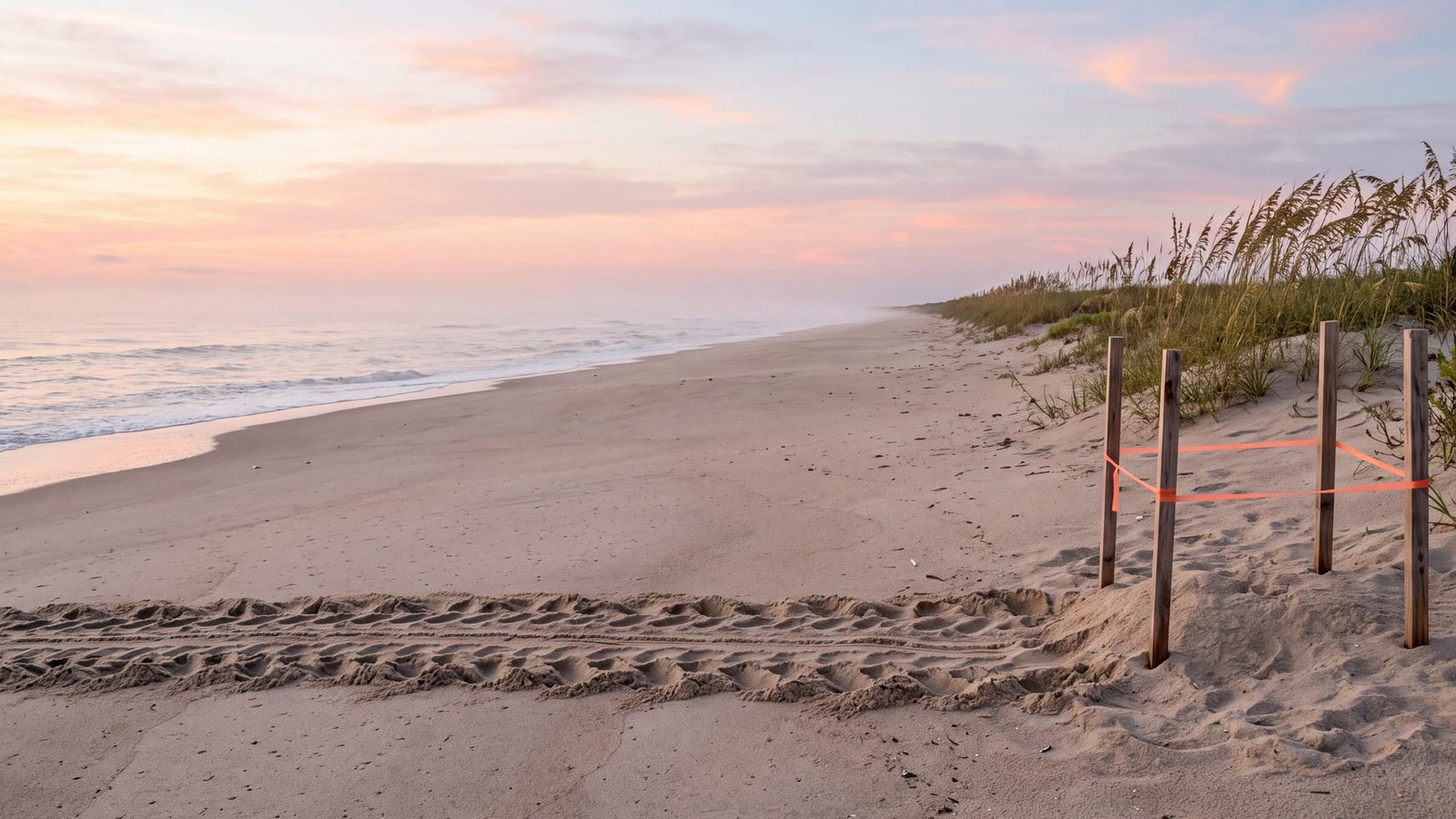
Every summer, on the same beaches you walk in the daytime, sea turtles come ashore at night to bury their eggs. The Outer Banks is the far northern edge of where they do it — the Park Service calls these beaches “the extreme northern limits of their nesting grounds” — and yet in a good year more than four hundred nests go in between Corolla and Ocracoke. Every one of them gets found, staked off and watched over by people who walk the beach at dawn.
This page is where and when it happens, what the stakes on the dune mean, what it does to beach driving in August, and how to see it without wrecking it. The shorebirds that nest on the points and spits get their own section at the end, because their closures are the ones that catch drivers out.
Nests counted so far this year
Three programs cover the coast and report their nests to the same database. The counters below are live:
Live year-to-date counts from seaturtle.org, where the monitoring programs report their nests.
Where they nest: the three monitoring areas
Nobody publishes where the nests are — a nest with a crowd around it is a nest in trouble — but the beaches themselves are no secret. Three groups divide the coast:
These are the areas each program patrols, not nest locations — nobody publishes those, on purpose. Map data © OpenStreetMap contributors.
- Virginia line to South Nags Head — N.E.S.T., the Network for Endangered Sea Turtles, a volunteer group that patrols more than 50 miles of beach from Carova to Nags Head every morning of the season. Their 24-hour hotline is (252) 441-8622.
- Oregon Inlet to Rodanthe — Pea Island National Wildlife Refuge. No vehicles on the beach at all, and the refuge closes from sunset to sunrise, which is exactly when the turtles are working.
- Bodie Island, Hatteras Island and Ocracoke — Cape Hatteras National Seashore, where the Park Service’s own crews do the patrolling. This is where most of the nests are: in early September 2026 the Seashore’s tally stood at 408 nests, and roughly seven in ten of them were on Hatteras Island (294), with 94 on Ocracoke and 21 on Bodie Island.
Who nests here
Loggerheads, overwhelmingly. Then greens, whose numbers swing from a handful to fifty-odd from one year to the next. Kemp’s ridleys and leatherbacks turn up a few times a season at most, and the Park Service lists the hawksbill as a rare visitor. The record year on the Seashore was 2019, and the lean years are lean:
| Year | Cape Hatteras National Seashore | Loggerhead | Green | Other |
|---|---|---|---|---|
| 2019 (record) | 473 nests | 440 | 32 | 1 Kemp’s ridley |
| 2023 | 380 | 323 | 53 | 1 leatherback, 3 Kemp’s |
| 2024 | 303 | 297 | 3 | 2 leatherback, 1 Kemp’s |
| 2025 | 218 | 193 | 21 | 3 Kemp’s |
Counts from the state’s nest database, where the Seashore reports them; the Park Service’s own low was 11 nests in 1987. Pea Island and the northern beaches add a few dozen each in a typical year.
When: the calendar
Nesting runs from May through September, and it happens at night. A female crawls up above the high-tide line, digs a chamber with her back flippers, lays about a hundred eggs, covers them and goes back to sea before sunrise. What she leaves behind is a crawl — two lines of flipper marks like a tractor track — and that is what the patrols are looking for at dawn. A crawl with no nest at the end of it is a false crawl; the Seashore logged more of those than nests in 2026.
The eggs take about 60 days, a little less in hot sand, and the hatchlings come up at night too, in a rush, and head for the brightest horizon. On a natural beach that is the sea. Hatching therefore runs from July into the fall, and the Park Service’s public nest excavations, where a crew digs out a hatched nest a few days after the emergence and counts the shells, are held in August and September.
What the stakes on the beach mean
When a nest is found it gets a square of wooden posts, string and signs around it, about 33 feet on a side. It is closed to vehicles, to walkers and to dogs. That is the small version, and you can walk past it all summer.
Around day 50 to 55 the closure grows. The Park Service widens it to roughly 100 feet and runs it all the way from the dune to the water, so the hatchlings have a clear, dark lane to the sea. On a beach with a vehicle route on it, that cuts the route: there is no driving around a closure that reaches the surf, so for a few days a stretch of beach is simply closed to trucks. Three to five days after the hatch the crew excavates the nest and the posts come down. In August and September that is the single most common reason a piece of Seashore beach is closed, and it is why the daily ramp status changes so often late in the summer.
The same logic is behind the night rules for driving on the Seashore. From May 1 through July 31 the priority ramps (2, 4, 25, 27, 43, 44, 48, 49, 70 and 72) open at 6 a.m. and every ramp closes at 9 p.m.; August 1 through September 30 the priority ramps open at 6:30; October 1 through November 15 everything opens at 7 a.m. and closes at 9 p.m.; and from November 16 through April 30 the beach is open to driving around the clock. Your regular ORV permit covers all of it — there is no separate night permit. The Park Service says a route can go back to night driving from mid-September if no nests are left on it, which is why the dates loosen in the fall. Beach fires follow the turtles too: May 1 through November 15 they are allowed only at Coquina Beach, the Ocracoke day-use area and the village beaches, with a free permit.
The rules that matter, wherever you are
- Fill in your holes before you leave. Nags Head, Kitty Hawk and Currituck County all ban leaving holes in the beach, and each ordinance says why in so many words: holes trap turtles that use the beach at night. Kill Devil Hills and Duck ask the same thing. A nesting female that falls into a hole may not get out; hatchlings certainly will not.
- Take everything off the beach at night. Chairs, tents, canopies and toys left out are a wall between a turtle and her nest site. Nags Head clears the beach from 8 p.m. to 6 a.m., Kitty Hawk and Currituck from sunset to sunrise, and the Park Service treats anything left overnight as abandoned.
- Lights off, blinds closed. No Outer Banks town has a lights-out law — we checked the codes — so this one is on you. A porch light or a lit oceanfront window is the brightest horizon a hatchling can see, and it will walk toward it instead of the water. The Park Service asks visitors to close blinds and turn off unnecessary outside lights during the season.
- If you meet a turtle: stay at least 30 feet back, stay quiet, no flashlights, no flash photography, keep the dog away, and never get between her and the sea. Handling a turtle or a hatchling without a permit is illegal.
- Don’t dig at the stakes, and don’t move them. If you think a nest is hatching, watch from a distance and let it happen.
How to actually see one
You cannot book a turtle. What you can do is walk the northern beaches around sunset in August and September: N.E.S.T. volunteers set up at nests that are due to emerge, they do not publish where, and in their own words, “if they come across a nest being monitored, we love to have visitors sit down and join us!” Bring a red light or none, sit where they tell you, and be prepared to wait for nothing — most nights nothing is what happens, and then one night it is not.
On the Seashore, the Park Service holds public nest excavations in August and September, a few days after a nest has hatched. A ranger digs out the chamber by hand, counts the hatched shells and the unhatched eggs, and now and then finds a straggler still in the nest, which is the moment everyone came for.
| If you find… | Call |
|---|---|
| A turtle, a nest or a stranded turtle, Virginia line to South Nags Head | N.E.S.T. 24-hour hotline, (252) 441-8622 |
| Anything turtle-related on Cape Hatteras National Seashore | Park Service, (252) 216-6892 |
| A stranded or dead turtle anywhere in North Carolina | State stranding hotline, (252) 241-7367 |
Report, don’t rescue. Dead or alive, the people on the other end of these numbers want the call.
The other nesters: shorebirds and the closures at the points
Turtles close small pieces of beach for a few days. Birds close the best pieces for months. Every spring, by March 15, the Park Service fences off the places where piping plovers, American oystercatchers and colonies of terns and skimmers nest on the ground: Bodie Island spit, Cape Point, the South Beach below the Point, the north end of Ocracoke and Ocracoke’s South Point. Posts, string, flagging tape and signs go up before the birds arrive, and the closed area grows if chicks hatch, because a plover chick on foot needs a lot of room: the buffer around a plover nest is about 165 feet, and with chicks in a vehicle area it can stretch to a third of a mile. Oystercatchers get roughly 500 to 650 feet, least terns about 330 feet, other colonial waterbirds close to 600 feet.
That is why Cape Point, the most famous fishing beach on the coast, can be reachable one week and cut off the next, and why the answer to “is the Point open?” changes through the summer as chicks fledge and buffers come down. The Park Service posts the current picture at go.nps.gov/beachaccess, sends it by text if you send CAHAORV to 333111, and says plainly that “whatever is posted in the field is the official status.” We keep a ramp-by-ramp version that rebuilds every morning. Pea Island is simpler: no vehicles on the refuge beach at any time, and the refuge posts its own bird and turtle closures.
For scale, the 2026 season as the Seashore counted it in early September: 45 oystercatcher nests, three piping plover nests with six chicks fledged, and more than 700 colonial waterbird nests — the terns and skimmers that nest in crowds on the spits. Those numbers move every week; the point is that the closures are not arbitrary and they are not permanent.
Asked and answered
When do sea turtles nest on the Outer Banks?
From May through September, at night. The eggs incubate for about 60 days, so hatching runs from July into the fall, also at night. Loggerheads are the main nester, with greens second and the occasional Kemp's ridley or leatherback.
Can you watch sea turtles hatch on the Outer Banks?
Sometimes, with luck and patience. On the northern beaches the N.E.S.T. volunteers sit at nests due to emerge around sunset in August and September and welcome visitors who happen upon them, though they do not publish nest locations. On Cape Hatteras National Seashore the Park Service holds public nest excavations in August and September, a few days after a nest hatches.
What do the wooden stakes on the beach mean?
A staked square is a sea turtle nest. It is closed to people, vehicles and dogs. About 50 to 55 days after the eggs were laid the closure is widened to roughly 100 feet and extended to the water so the hatchlings have a dark lane to the sea; a few days after the hatch the nest is excavated and the stakes come down.
Can you drive on the beach at night during turtle season?
On Cape Hatteras National Seashore, no. From May 1 through November 15 the ramps close at 9 p.m. and open between 6 and 7 a.m. depending on the month and the ramp; from November 16 through April 30 the beach is open to driving around the clock. Your regular ORV permit covers night driving when it is allowed; there is no separate permit.
Why is Cape Point closed?
Usually for nesting shorebirds. Piping plovers, American oystercatchers and colonies of terns and skimmers nest on the ground at the points and spits, so the Park Service fences those areas by March 15 each year and widens them if chicks hatch. The closures shrink as the birds fledge through the summer. Late in the summer a turtle nest about to hatch can also close a short stretch of beach for a few days.
Who do I call if I find a sea turtle on the beach?
From the Virginia line to South Nags Head, the N.E.S.T. 24-hour hotline at (252) 441-8622. On Cape Hatteras National Seashore, the Park Service at (252) 216-6892. Anywhere in North Carolina, the state stranding hotline at (252) 241-7367. Do not touch the turtle; handling one without a permit is illegal.
Checked against the sources
Species, season, incubation, hatchling behavior, the visitor rules, the reporting number and the beach-fire rule are from the National Park Service’s Cape Hatteras National Seashore pages on sea turtles, nest excavations and beach activities. The nest-closure protocol (the staked square, the widening to the water at day 50–55, excavation three to five days after the hatch) is the Seashore’s published procedure, stated by the Park Service in metric and converted here to feet. Night-driving hours and priority ramps are from the Park Service’s ORV questions page.
Nest counts by year and species are from the North Carolina sea turtle nest database at seaturtle.org, where the Seashore, Pea Island refuge and N.E.S.T. report; the live counters draw from the same database. The 2026 Seashore figures (nests, false crawls, hatched nests by island, shorebird nests) are from the Park Service’s field summary as updated September 3, 2026, which the Park Service itself labels estimates.
N.E.S.T. coverage, hotline and the nest-sit invitation are from nestobx.org. Shorebird closure dates, sites and buffers are from the Park Service’s pre-nesting page and its published annual monitoring reports. Town rules on holes and overnight equipment are from the Nags Head, Kitty Hawk and Currituck County codes and the Kill Devil Hills and Duck beach pages; we searched those codes for a lighting ordinance and found none. The state stranding number is from NOAA’s stranding-network directory.
What we sell: nothing on this page. The map shows the areas each program patrols, drawn by us along the beach; it does not show nests. Last checked: September 2026.