
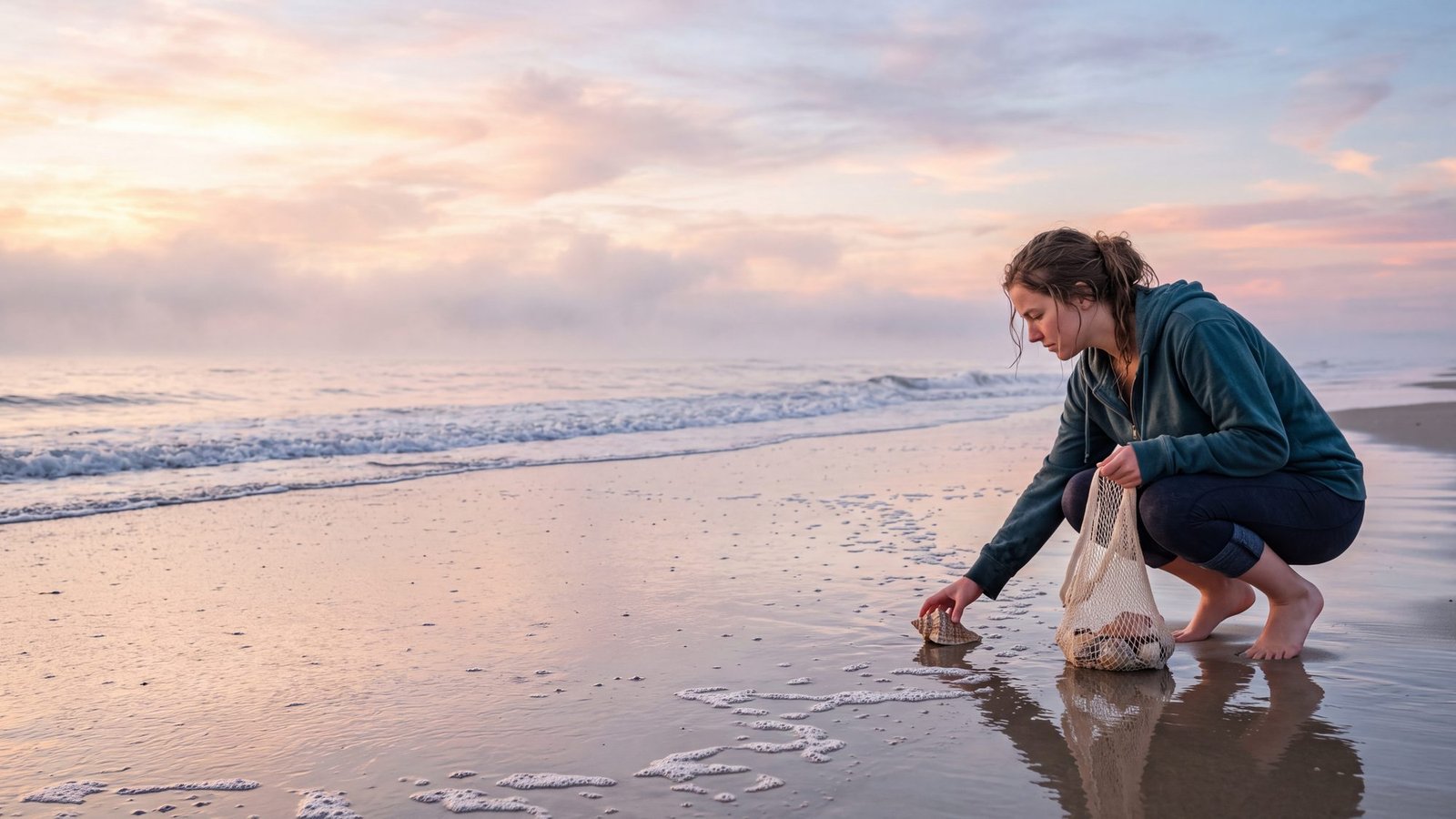
Outer Banks shelling is better than most people expect, and the reason is geography. The Outer Banks sits at a collision point: cool Mid-Atlantic shelf water meets the warm Gulf Stream off Cape Hatteras, at one of the sharpest marine biogeographic boundaries in the world, and the wreckage of that meeting includes seashells from two worlds — temperate and subtropical species overlapping here in a way they do not anywhere else on this coast. It’s why Coastal Living ranked Ocracoke the #2 shelling beach in the country back in 2007, behind only Sanibel Island — in an article that opened on winter storms.
The eight beaches below are the proven grounds, north to south. The short version of everything that follows: go at low tide, go early, go in the off-season if you can — and give a storm a few days to deliver before you judge it. Winter does most of that work for you — and across the whole October-to-April season only thirty-seven mornings put a low tide beside sunrise, which is why the dates are worth picking deliberately.
Save this map to your phone for offline use
Where the shells are
Up north, Carova’s 4WD beaches pair limited access with a gently sloping ocean floor, so delicate augers and olive shells arrive unbroken on sand few people comb. Kitty Hawk is the beachcomber’s beach — driftwood, sea glass, scallops. Coquina Beach delivers exactly what its name promises, including the summer spectacle of live coquina clams shimmying back into the sand between waves. The inlet edges — Oregon Inlet especially — collect what the current carries, including ocean-tumbled purple quahog pieces known as wampum.
Pea Island hides sea glass in its low-tide pebble beds. And then the main event: South Beach at Cape Point, the south-facing sand on the hook itself, where the helmet conchs and Scotch Bonnets wash up for whoever’s there — often nobody, in January. Frisco and Hatteras beaches sit over a shallow shelf that lands fragile shells without a scratch, and Ocracoke — all of it — is the national-ranking closer. True obsessives take the boat from Ocracoke to Portsmouth Island, the uninhabited shelling mecca one island south.
One myth-bust while we’re here: Shelly Island, the famous sandbar that appeared off Cape Point in 2017, is gone — reclaimed by the same currents that built it. The walk toward the Point where it stood is still some of the best shelling on the coast.
Which of those you can actually reach depends on what you are driving. Here is the same list again, by access.
| Beach | Getting there | Notes |
|---|---|---|
| Carova | 4x4 only | No paved road reaches it — you drive on where the highway ends in Corolla. Outside the May-to-September permit season there is nothing to buy. |
| Kitty Hawk | Walk on | Public beach accesses with parking off the highway. |
| Coquina Beach | Walk on | Three paved lots and a bathhouse. ORV Ramp 2 is right there if you are driving anyway. |
| Oregon Inlet | Either | Paved parking at the inlet, and Ramp 4 just north of it. |
| Pea Island | Walk on | A national wildlife refuge with no ORV ramps at all — the federal ramp list skips from 4 to 23 around it. |
| South Beach, Cape Point | 4x4 in practice | Ramps at Buxton and Frisco put you on the sand. On foot it is a long walk from the nearest lot. |
| Frisco and Hatteras | Either | Paved village accesses, plus ramps onto the sand. |
| Ocracoke | Either | Six ORV ramps — and 6.45 of its 16.75 seashore miles are permanently walk-only. |
| Portsmouth Island | Boat only | About twenty minutes across Ocracoke Inlet, by an operator the Park Service authorises. |
Do you need a 4x4?
For some of it, yes — and the honest way to put it is that the two Outer Banks spots Visit North Carolina names by name are both places an ordinary car cannot reach. Its channeled-whelk recommendation is Corolla and north “where the blacktop ends,” which is the Carova four-wheel-drive beach. Its lightning-whelk recommendation is the stretch between Buxton and Frisco, which is a sand drive.
But plenty of this list is walk-on, and that is not a consolation prize. Pea Island has no ramps at all. Coquina Beach has three paved lots. Nearly four miles in ten of Ocracoke’s seashore beach is permanently closed to vehicles — which is exactly why it stays un-picked-over. A beach nobody drives is a beach nobody has combed from a truck window.
So the rule of thumb. If you want Carova or Cape Point, you want a four-wheel-drive and the right permit. If you want Pea Island, Coquina or the walk-only miles on Ocracoke, you want boots and an early alarm. Both are real shelling; they are just different mornings.
And one thing worth knowing before you assume you need to rent anything: the beach is public from the waterline to the first line of stable natural vegetation, so every one of these is walkable from a public access if you are willing to put the miles in. The vehicle buys you distance, not permission.
The shelling clock
Low tide rules everything — the productive window is the hour on each side of it, when the high tide’s deliveries sit exposed. Check the tide chart before you commit a morning — and check the right one. On Ocracoke especially, the chart most phones hand you is the harbor gauge on the sound side, running a tide barely a third the size of the one on the ocean beach you are standing on. That trap is worth understanding before you plan around it.
Storms are the great restockers, with a catch nobody mentions: immediately after a blow the beach is often scoured clean — the shells arrive a few days later on the gentler waves, so give a storm its delivery time. Full and new moons swing the tides hardest and expose the most beach. And the off-season, October through April, is when the serious finds happen: it is nor’easter season — the National Weather Service puts those storms at their most frequent and most violent from September to April — and nobody’s there to compete. First light beats mid-morning every single day.
The day trip after a storm
Tides can be planned months out. Storms cannot. A nor’easter shows up in the forecast a few days ahead, blows for a few days and moves on — and if you live within a couple of hours of the bridges, the day trip behind it is the best shelling you can get for a tank of gas.
Out of hurricane season, the storm doing the restocking is a nor’easter: low pressure that forms off the coast and drives wind onto the beach from the northeast. That is the easterly blow Visit North Carolina ties to the best shelling. The forecast to watch for is a Coastal Flood Watch for the Outer Banks with northeast wind holding for more than a day.
Go behind it, not into it. Let the wind drop and the surf lie down. Right after a blow the beach is often scoured bare; the shells come in on the gentler waves that follow. A day after the wind quits is the soonest worth the drive, and two or three is often better.
Pick a midday low, not a dawn one. A day-tripper cannot make a sunrise tide and does not need to. Low tide runs about fifty minutes later each day, so within a week of every dawn low there is a run of days when the low lands in the middle of the day. On about one day in three, a low falls between 10 a.m. and 2 p.m. Check the tide chart, leave after breakfast, work the hour either side of low, and be back over the bridge before dark. In December the sun is down before five.
Check the road and the ramps before you leave the driveway. The blow that loads the beach is the same one that puts the ocean across NC 12. South of Oregon Inlet the highway can stay closed a day or more while crews clear the sand — DriveNC.gov and the NCDOT NC 12 page on Facebook carry the status. The Park Service closes ORV ramps when a storm makes them unsafe and reopens them as each is checked; the live list is at go.nps.gov/beachaccess (we rebuild it every morning here, NC 12 included), and texting CAHAORV to 333111 gets you the alerts. Stay off the beach in front of Buxton village and Rodanthe after a storm — the Park Service has closed both more than once because of collapsing oceanfront houses and the debris they leave.
From Corolla to Cape Point the Outer Banks face the open ocean to the east, so a northeast wind blows in off the water, often through several high tides in a row. The current along the beach carries the loosened sand south toward Cape Point, and much of it is thought to end up on Diamond Shoals.
- Wind from the northeast
- Sand drifting south along the beach
- Erosion and overwash hot spots
- The wind piles water against the beach, so the tide runs well above a normal high tide (the solid line against the dashed one).
- Waves reach the dune, cut into it and carry the sand offshore to sandbars. Calm weather brings much of it back over the following weeks and months.
- Where the dune is low, water and sand pour across North Carolina Highway 12.
Sources: National Weather Service, U.S. Geological Survey, and the Highway 12 Task Force list of overwash hot spots. Coastline from Natural Earth.
Where to point the car. From Hampton Roads it is roughly an hour and a half to two hours to the northern beaches. That puts Carova, Coquina Beach and the Oregon Inlet edges inside a day, with Pea Island just over the bridge when NC 12 is open. Carova is the one made for this: it is 4x4 only, so few people have walked it ahead of you, and in winter there is no county beach parking permit to buy. Cape Point is about 135 miles from Norfolk — close to three hours each way, and only when NC 12 is open. Ocracoke is not a day trip. From Richmond or Raleigh it is three to four hours each way, a long drive for a short tide; stay the night and use the dawn-tide calendar instead.
If you are driving the sand, expect a different beach from the one in the photos: narrower, with a step cut into it by the surf, and debris along the high-tide line. Drive it around low tide, when the beach is widest, and be off the sand well before high. Winter beach driving, in full.
The trophy list
The grail is the Scotch Bonnet — North Carolina’s state shell since 1965, chosen to honor the state’s early Scottish settlers, its spotted pattern named for tartan. Two to four inches, genuinely rare, and your best odds are Ocracoke and points south. Below it on the podium: whelks in their lightning, channeled, and knobbed varieties (some run enormous), helmet conchs, olive shells, augers, moon snails (the “shark’s eye”), keyhole sand dollars, and the craft-shop favorites — wampum for jewelry, sea glass for jars, and the odd shark tooth for bragging.
The rules of the hunt
Empty shells only, and both national seashores publish a number: one 5-gallon bucket of uninhabited shells per person per day, not for commercial use — and “empty” requires checking: a fuzzy sand dollar is a living sand dollar, and anything with a resident, a hermit crab included, goes back in the water. Taking a live whelk is harvesting rather than collecting: North Carolina allows ten per person per day, twenty per vessel, no license needed for shellfish, and live bay scallops are closed and unlawful to possess.
Respect posted bird and turtle closures — they go up as birds arrive and come down as nests hatch, on no fixed calendar, which is a different thing from the seasonal village driving routes that open October 15 and close April 14 — and if you find a stranded or injured sea turtle, the number depends where you are — N.E.S.T. runs the shore patrols from the Virginia line down to South Nags Head on 252-441-8622, and on Hatteras and Ocracoke it is the National Seashore on 252-216-6892. North Carolina law makes the beach public from the waterline to the first vegetation, so comb freely; just leave the dunes alone. Two buckets is the local custom: one for shells, one for any trash you pass. The beach pays that back.
Frequently Asked Questions
Locally verified
Reviewed by the Beach4x4 team in Kill Devil Hills, NC
Last checked: September 2026
Sources: the official park, town and county pages for this topic. Always confirm hours, fees, and closures with the official source before you go.
What is the best shelling beach on the Outer Banks?
South Beach at Cape Point in Buxton for sheer quality, and Ocracoke Island for the full experience — Coastal Living ranked Ocracoke the #2 shelling beach in the U.S. in 2007, behind only Sanibel Island.
When is the best time to find shells on the OBX?
The hour on either side of low tide, at first light, ideally a few days after a nor’easter or other big storm (not immediately after — the beach is often scoured clean at first). October through April is the serious season, and only about three dozen winter mornings put a low tide next to sunrise.
Where can I find a Scotch Bonnet?
North Carolina’s state shell is genuinely rare — your best odds are Ocracoke Island and the boat trip to Portsmouth Island, especially in winter after storms.
Is it legal to take shells from Outer Banks beaches?
Yes, and there is a published limit: one 5-gallon bucket of uninhabited shells per person per day, not for commercial use, at both Cape Hatteras and Cape Lookout National Seashores. The beach is public from the waterline to the first line of stable natural vegetation. Occupied shells and live sand dollars (the fuzzy ones) go back in the water, and posted nesting closures are off-limits.
Related OBX Guides
Combine a shelling trip with a look at the Outer Banks shipwrecks visible from the same beaches, check the tide charts before you go, plan the trip around the winter mornings when low tide lands on sunrise, read the island-by-island detail for shelling on Ocracoke, or browse everything else in our Things to Do in the Outer Banks guide.