
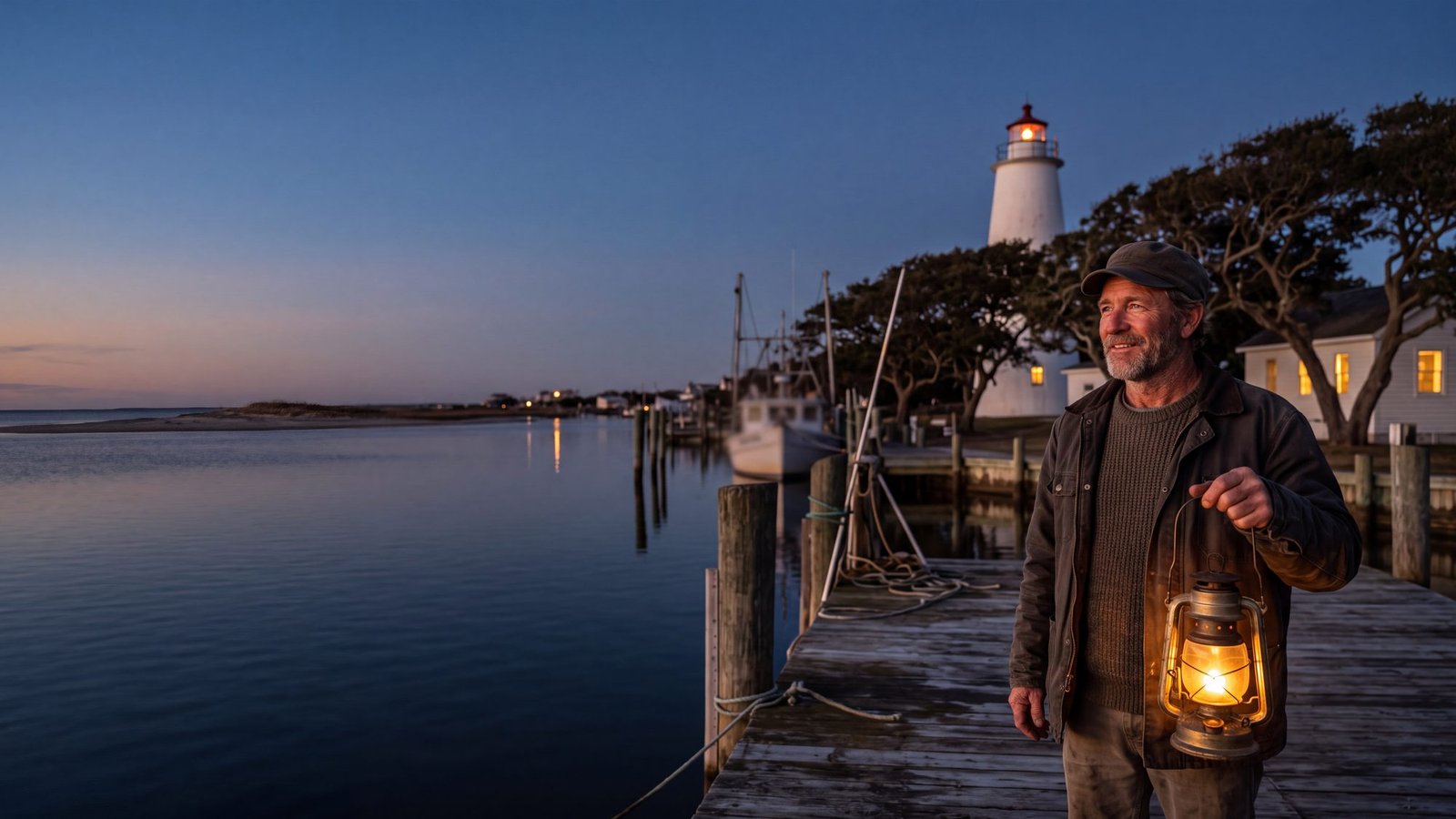
Blackbeard was killed in the water off Ocracoke Island on November 22, 1718, and the channel where it happened is still called Teach’s Hole on the charts. You can stand on the shore and look at it.
What actually happened at Ocracoke
Alexander Spotswood, Virginia’s lieutenant governor, decided Blackbeard was a threat to Virginia’s shipping and sent a Royal Navy force to hunt him down — in another colony’s waters, which was its own kind of scandal. Lieutenant Robert Maynard came south with two sloops, the Jane and the Ranger. Ocracoke Inlet is a maze of shoals and both sloops ran aground during the fight.
Blackbeard nearly won it. He raked Maynard’s deck and boarded, believing he had killed most of the crew — Maynard had hidden his men below. They came up, and the fight went hand to hand. Twelve pirates died, eight of them in that boarding action. Blackbeard took five pistol shots and twenty cutlass wounds before a Scottish highlander cut his neck open with a broadsword.
Maynard cut off his head and hung it from the bowsprit as proof, and threw the body into the sea. That is the part the legends grew out of: no grave, no body, a head sailing back to Virginia on the front of a ship.
Is Blackbeard’s treasure real?
Nobody has found it, and the paper trail leans the dull way. Maritime historians at Royal Museums Greenwich put it plainly: pirates burying treasure is very likely a myth. What crews actually seized was cargo — spices, silk, wine, sugar, medical supplies. Trade goods. You cannot bury a hold full of wine in a sandhill and come back for it in five years, and there was no reason to: the point of taking cargo was to sell it fast.
The buried-chest idea comes largely from fiction, not from the record. Most of what anyone knows about Blackbeard at all traces back to one book — Captain Charles Johnson’s A General History of the Pyrates, published in 1724, six years after the man died. It is the source of the smoking-fuses-in-the-beard image and a good deal else that historians still argue about.
Even his name is uncertain. He appears in the documents as Teach, Thatch, Thache and Thack, was possibly born in Bristol around 1680, and his entire career as a pirate captain lasted no more than two years. What has actually come out of the ground, and where people have dug, is accounted for on Has Blackbeard’s treasure ever been found?, and the inlet itself, charted from 1590 to today, is in the case file.
Blackbeard in the show — kind of
The last two seasons of Outer Banks are a Blackbeard hunt. Wes Genrette hands the Pogues Blackbeard’s captain’s log, they dive the wreck of his sloop Adventure for an amulet with directions cut into it, the Mogador Scroll sends them to Morocco, and inside a statue in Essaouira they find the Blue Crown, the prize Blackbeard was supposedly chasing. The final season carries the crown to a lake in Azerbaijan and back into the hands of the Corsairs. On the show’s telling, Blackbeard’s ship went down on a sandbar in 1718 and a Genrette caught and killed him.
Kind of. The ship on the sandbar is real: the Queen Anne’s Revenge ran aground at Beaufort Inlet in June 1718, the wreck was found in 1996, and the state has been bringing it up piece by piece ever since. The sloop is real too; Adventure was the vessel Blackbeard kept after the grounding and the one he had at Ocracoke. The death is real, minus the Genrette: Lieutenant Robert Maynard’s Royal Navy crew killed him at Ocracoke on November 22, 1718, five months after the grounding, and the fight is laid out at the top of this page. The captain’s log, the amulet and the Blue Crown are the show’s own; no record puts a Persian crown anywhere near him. What the writers borrowed is the oldest question on this coast: he died here, and whatever he had was never produced.
The trail the Pogues never walked is the one you can. Springer’s Point, where he anchored and died, is a public preserve at the end of a sand path in Ocracoke village, and Blackbeard’s Gold: The Crossing is the hunt built on that exact ground: it opens in the Hatteras ferry line and ends at the water off the Point. Kildare Island, the show’s island, is this coast under another name; the Kildare Island page and the filming-locations map sort the two apart.
Do they find Blackbeard’s treasure in Outer Banks?
Kind of. In Season 4 the Pogues follow Blackbeard’s captain’s log to an amulet from his wrecked sloop Adventure and on to the Blue Crown, which they find inside a statue in Essaouira, Morocco. In Season 5 the crown goes to a lake in Azerbaijan and ends up back with the Corsairs, so the crew finishes the series without it. The gold they rebuild Kildare Island with is the Royal Merchant’s, not Blackbeard’s.
What is Blackbeard’s treasure in the show?
The Blue Crown, a crown the show traces from Darius the Great through Xerxes, Alexander and Caesar to Blackbeard, who was supposedly hunting it when he died. The trail runs from his captain’s log to an amulet on the wreck of his sloop Adventure, then to the Mogador Scroll and Morocco. The crown is the writers’; the real Blackbeard’s plunder was trade cargo, and none of it has ever been produced.
Is the Blackbeard story in Outer Banks real?
Kind of. Blackbeard’s ship really did go down on a sandbar in 1718: the Queen Anne’s Revenge, at Beaufort Inlet, found in 1996 and still being excavated. He really did die that year at Ocracoke, on November 22, killed by Lieutenant Robert Maynard’s crew rather than by a Genrette. The captain’s log, the amulet and the Blue Crown are the show’s inventions. Springer’s Point on Ocracoke, where he anchored and died, is a real place you can walk to.
The one real treasure — and it isn’t gold
On November 21, 1996 — almost 278 years to the day after he died — a private research firm found a wreck in 28 feet of water about a mile off Fort Macon State Park, near Atlantic Beach. North Carolina confirmed it in August 2011 as the Queen Anne’s Revenge, Blackbeard’s flagship, lost in 1718.
More than 300,000 artifacts have come up from it. Two dozen cannons. An anchor weighing close to a ton. A brass coin weight stamped with Queen Anne’s head, a wine glass stem made for George I’s coronation in 1714, a Paris-made medical syringe, and paper fragments from a voyage book that had been rammed down a cannon barrel as wadding. Those small dated objects are how the ship was identified.
No gold yet, and no chests. The most valuable thing that has ever come out of a Blackbeard site is a scrap of paper used as gun wadding, and it is worth more than gold would be, because it tells you something true. Artifacts from the wreck are on display at the North Carolina Maritime Museum in Beaufort.
What you can actually visit on Ocracoke
Springer’s Point. A 132-acre maritime forest preserve on the south end of the village, on the ground Blackbeard is said to have used as an anchorage and camp. Live oaks, a short trail, and a shoreline that opens onto the water where he died. Free, foot access only; check current hours before you go.
Teach’s Hole. Not a museum — a channel. You look at it from the Springer’s Point shoreline. It has carried his name for three hundred years and it is the only marker the event ever got.
Silver Lake. The village harbor. The same sheltered water his fleet used, now full of charter boats and the ferry.
Ocracoke Lighthouse, built in 1823, and the National Park Service visitor center, which runs programs on the island’s pirate history in season.
Getting there matters as much as being there: Ocracoke has no bridge. You arrive by ferry or not at all — see our Outer Banks ferry guide and the Ocracoke island map before you plan a day around it.
Hunt it yourself
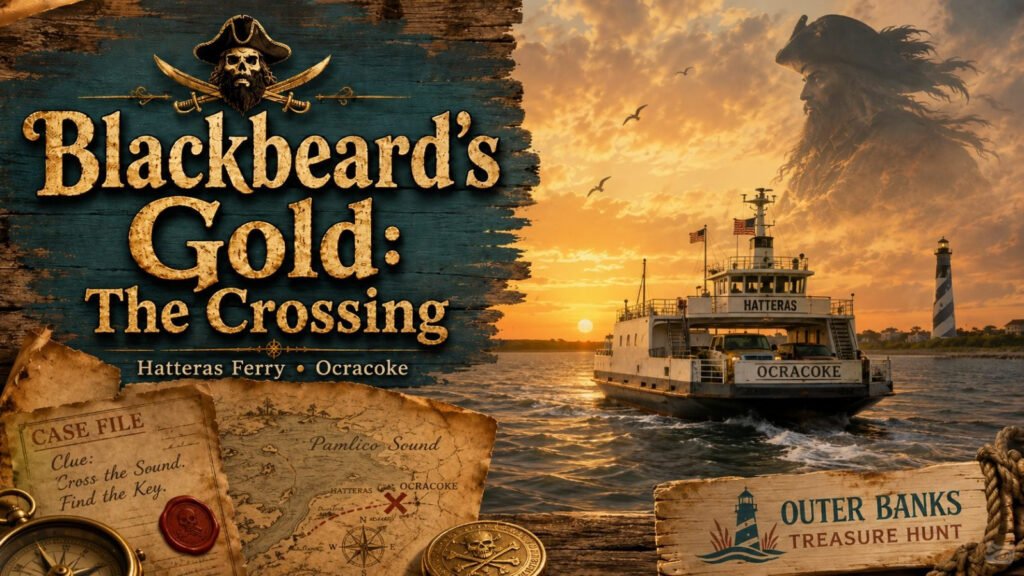
We built a self-guided hunt around exactly this question. Blackbeard’s Gold is a treasure hunt you play on your phone through Ocracoke Village, on the island where he actually died — the same trail as everyone who has ever gone looking for his gold, worked one stop at a time.
What waits at the end is not a chest. It is the answer to where that gold went — which is a better story, and one most people who go looking never get.
The Ocracoke side of the story now has a site of its own: where Blackbeard died, what divers actually recovered, and why the gold has never turned up — along with every ferry route to the island.
How much of the Netflix version is real? Kind of — the show invented its island, but it borrowed this coast’s oldest questions. The rundown of what the show borrowed traces Kildare, the wrecks, and the gold back to where they started.