
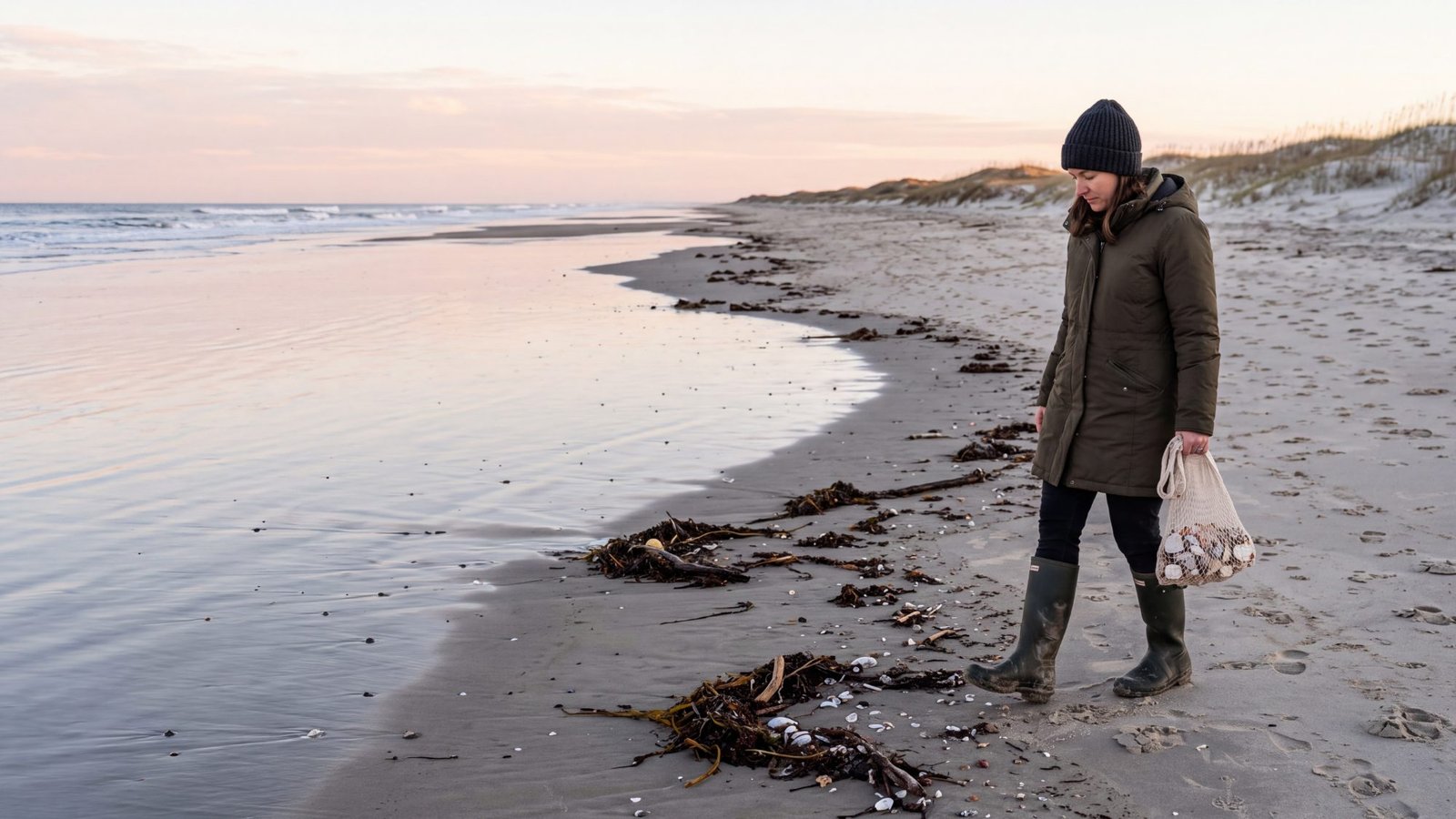
Every shelling guide written about this coast tells you the same three things: go at low tide, go early, and go after a storm. All three are true. What none of them tells you is that those three conditions hardly ever happen at the same time, and that the days they do can be worked out months ahead.
So we worked them out. We pulled the National Ocean Service tide predictions for the Cape Hatteras Fishing Pier and the sunrise times from the US Naval Observatory for every day of the seasonal beach-driving window, October 15, 2026 to April 14, 2027, and counted the mornings where a low tide falls within an hour and a half of sunrise.
Thirty-seven mornings out of a hundred and eighty-two. Twenty-two of them inside an hour. They arrive in tight little clusters roughly a fortnight apart — thirteen clusters across the season — and nine of those clusters carry a Saturday or a Sunday. Three run into a Monday holiday.
The short answer
Winter genuinely is the better season, and not because the beach is empty — though it is. Nor’easters are most frequent between September and April, they blow out of the northeast, and an easterly blow is the thing that puts shells on the sand.
The catch is timing. Low tide slides about fifty minutes later each day, so the dawn low you want comes round in bursts, not on demand. The dates are below.
Nine of the season’s thirteen clusters carry a weekend. January 15 to 17 runs into the Monday holiday; February 13 to 15 is Valentine’s Sunday and the Presidents’ Day Monday, and the Sunday morning of that pair is the best of the whole season — sunrise and low tide to the same minute. All nine weekends are listed below.
And winter unlocks beach that summer closes. The village ORV routes on Hatteras run October 15 to April 14 only, and Currituck County’s beach parking permit season is over. Both are explained below.
Why the cold months are the good ones
This is not a local hunch. It is the position of just about every source that has looked at it.
The National Weather Service is plain about the weather half: nor’easters “may occur at any time of year but are most frequent and most violent between September and April,” and during one “the winds over the coastal area are typically from the northeast.” That matters because Visit North Carolina, the state tourism authority, puts the shelling half like this: the best time is “the hour on both sides of low tide, especially after a storm with strong easterly winds.”
Put the two sentences together and you have the argument. The wind that builds shells onto this beach is a winter wind.
The people who collect shells for a living say the same. The North Carolina Shell Club: “the winter months with more frequent storms wash more shells ashore,” while “quieter summer months with gentle surf do not wash as many shells ashore.” The Club also names this stretch of coast outright — “for the best shell collecting, the Outer Banks is the place to go” — and singles out Ocracoke, Portsmouth Island and Core Banks for the Scotch bonnet.
The Park Service agrees on the timing. Cape Lookout National Seashore lists the best times to go shelling as early morning, low tide, after storms, and the winter months.
Even the accolade people quote about Ocracoke came out of a winter story. When Coastal Living put Ocracoke second in the country for shelling behind Sanibel — that was 2007, and the ranking still gets repeated without the year — the article opened on the line “winter storms stir up a bounty of prize shell specimens on the shore.”
Three conditions, and why they miss each other
Take the advice apart and you are being asked for three things at once.
A recent blow. Not during — after. The Shell Club puts it as “in a few days shells often begin to wash ashore on gentler waves.” The surf has to lay down enough to deliver what it lifted.
Low tide. An hour either side of it, so the berm and the wrack line are out of the water. The ocean beach here runs a mean range of about three feet, which is enough to matter on a flat, wide beach.
First light. Not because dawn is magic, but because you want to be the first person down the beach. The Shell Club is blunt about it: “the early bird gets the worm.”
The first is luck. The second and third are arithmetic, and the arithmetic is unfriendly. This coast runs two lows a day, and the whole cycle takes about twenty-four hours and fifty minutes, so each low arrives roughly fifty minutes later than the day before. A low tide that sits on sunrise today is nearly an hour into the morning tomorrow and past lunch inside a week. Then it comes back round.
Across the 182 days from October 15, 2026 to April 14, 2027, a low tide falls within an hour of sunrise at Cape Point on twenty-two of them. Widen the window to ninety minutes and it is thirty-seven — about one morning in five. Every other day of the season, you are working a tide that is either long past or has not happened yet.
Which is the argument for the overnight, and there is no way round it. On the shortest days of the year, first light at Cape Point is 6:36 in the morning and the sun is up at 7:04. You are not driving in for that. You are either already on the island or you are getting there second.
Unless first light is not your game. If you live close enough to drive down and back in a day, the play is different: wait for a storm, let it pass, and come for a midday low instead of a dawn one. That is the day trip after a storm, and it needs no hotel.
The mornings that line up, October 2026 to April 2027
The window runs October 15, 2026 to April 14, 2027, which is not an arbitrary choice: it is the season the Cape Hatteras village ORV routes are open, and it brackets the months the shelling sources point at. Times are for Cape Point at Buxton. Sunrise and first light (the start of civil twilight, when there is enough light to see the sand) are from the US Naval Observatory; the low tides are National Ocean Service predictions for the Cape Hatteras Fishing Pier, station 8654400. ‘Gap’ is how far the low sits from sunrise: a minus figure means the tide bottoms out before the sun comes up, which is the better half of the pair, because the water is still on its way out when the light arrives.
The nine weekends
If you only want the bookable ones, these are the clusters with a Saturday or a Sunday in them. The morning shown is the best of each cluster; the days either side of it work too.
| Weekend | Best morning | Sunrise | Low tide | Gap | Why |
|---|---|---|---|---|---|
| Oct 17–19, 2026 Sat–Mon | Sun Oct 18 | 07:11 | 06:57 | -14 min | Opening weekend of the seasonal ORV routes. |
| Nov 1–2, 2026 Sun–Mon | Mon Nov 2 | 06:25 | 06:51 | +26 min | The clocks go back overnight on the Saturday. |
| Jan 15–17, 2027 Fri–Sun | Sat Jan 16 | 07:10 | 07:14 | +4 min | Runs straight into the Monday federal holiday. |
| Jan 28–30, 2027 Thu–Sat | Fri Jan 29 | 07:04 | 06:59 | -5 min | The Thursday low is the lowest water of the season. |
| Feb 13–15, 2027 Sat–Mon | Sun Feb 14 | 06:50 | 06:50 | dead on | Valentine’s Sunday, then a Monday holiday. The best morning of the season. |
| Feb 26–28, 2027 Fri–Sun | Sat Feb 27 | 06:35 | 06:23 | -12 min | A clean Friday to Sunday, and the light is coming back. |
| Mar 14–15, 2027 Sun–Mon | Mon Mar 15 | 07:13 | 07:36 | +23 min | The clocks go forward overnight on the Saturday. |
| Mar 27–29, 2027 Sat–Mon | Sun Mar 28 | 06:55 | 06:48 | -7 min | Over twelve hours of daylight to use afterwards. |
| Apr 11–13, 2027 Sun–Tue | Mon Apr 12 | 06:34 | 06:22 | -12 min | The last one. Seasonal ramps close on April 14. |
Every aligned morning of the season
All thirty-seven, grouped into the thirteen clusters they fall in.
| Morning | First light | Sunrise | Low tide | Gap | Why it matters |
|---|---|---|---|---|---|
| Saturday, October 17, 2026 | 06:44 | 07:10 | 05:58 | -72 min | The first cluster of the season, and the seasonal ramps opened two days earlier. |
| Sunday, October 18, 2026 | 06:45 | 07:11 | 06:57 | -14 min | |
| Monday, October 19, 2026 | 06:46 | 07:12 | 08:03 | +51 min | |
| Sunday, November 1, 2026 | 05:57 | 06:24 | 05:36 | -48 min | The clocks go back on the Sunday, so first light arrives an hour earlier. |
| Monday, November 2, 2026 | 05:58 | 06:25 | 06:51 | +26 min | |
| Monday, November 16, 2026 | 06:11 | 06:38 | 05:18 | -80 min | Midweek. Night driving restrictions lift on the Monday. |
| Tuesday, November 17, 2026 | 06:12 | 06:39 | 06:19 | -20 min | |
| Wednesday, November 18, 2026 | 06:13 | 06:40 | 07:24 | +44 min | |
| Monday, November 30, 2026 | 06:24 | 06:52 | 05:28 | -84 min | Midweek, straight after the Thanksgiving traffic has gone home. |
| Tuesday, December 1, 2026 | 06:25 | 06:52 | 06:41 | -11 min | |
| Wednesday, December 2, 2026 | 06:25 | 06:53 | 07:54 | +61 min | |
| Wednesday, December 16, 2026 | 06:36 | 07:04 | 05:41 | -83 min | Midweek, the week before the holidays. Quietest beach on this list. |
| Thursday, December 17, 2026 | 06:36 | 07:05 | 06:43 | -22 min | |
| Friday, December 18, 2026 | 06:37 | 07:05 | 07:48 | +43 min | |
| Wednesday, December 30, 2026 | 06:42 | 07:10 | 06:21 | -49 min | Straddles New Year’s. |
| Thursday, December 31, 2026 | 06:42 | 07:11 | 07:32 | +21 min | |
| Friday, January 1, 2027 | 06:43 | 07:11 | 08:40 | +89 min | |
| Friday, January 15, 2027 | 06:43 | 07:10 | 06:08 | -62 min | Friday to Sunday, and the Monday after is a federal holiday. |
| Saturday, January 16, 2027 | 06:43 | 07:10 | 07:14 | +4 min | |
| Sunday, January 17, 2027 | 06:42 | 07:10 | 08:24 | +74 min | |
| Thursday, January 28, 2027 | 06:37 | 07:04 | 05:53 | -71 min | Thursday to Saturday, and the Thursday low is the lowest water of the season. |
| Friday, January 29, 2027 | 06:37 | 07:04 | 06:59 | -5 min | |
| Saturday, January 30, 2027 | 06:36 | 07:03 | 08:08 | +65 min | |
| Saturday, February 13, 2027 | 06:25 | 06:51 | 05:44 | -67 min | Saturday to Monday. The Sunday is Valentine’s Day and the Monday is a federal holiday. |
| Sunday, February 14, 2027 | 06:24 | 06:50 | 06:50 | dead on | |
| Monday, February 15, 2027 | 06:23 | 06:49 | 08:02 | +73 min | |
| Friday, February 26, 2027 | 06:10 | 06:36 | 05:23 | -73 min | Friday to Sunday, and the days are getting usefully longer. |
| Saturday, February 27, 2027 | 06:09 | 06:35 | 06:23 | -12 min | |
| Sunday, February 28, 2027 | 06:08 | 06:33 | 07:30 | +57 min | |
| Sunday, March 14, 2027 | 06:49 | 07:14 | 06:30 | -44 min | The clocks go forward on the Sunday, which pushes sunrise back an hour. |
| Monday, March 15, 2027 | 06:48 | 07:13 | 07:36 | +23 min | |
| Saturday, March 27, 2027 | 06:31 | 06:56 | 05:54 | -62 min | Saturday to Monday, with over twelve hours of daylight behind it. |
| Sunday, March 28, 2027 | 06:29 | 06:55 | 06:48 | -7 min | |
| Monday, March 29, 2027 | 06:28 | 06:53 | 07:48 | +55 min | |
| Sunday, April 11, 2027 | 06:09 | 06:35 | 05:25 | -70 min | The last cluster before the seasonal ramps close on April 14. |
| Monday, April 12, 2027 | 06:08 | 06:34 | 06:22 | -12 min | |
| Tuesday, April 13, 2027 | 06:07 | 06:33 | 07:25 | +52 min |
North of Oregon Inlet the tide runs a few minutes behind these times and the sun comes up a couple of minutes later, so the same mornings work at Duck, Corolla and Carova. The dates do not move; only the minutes do. South at Ocracoke it is tidier still: we ran the same calculation against NOAA’s Ocracoke Inlet station and got the same mornings, all but one, with the low exactly eleven minutes later every time — which is NOAA’s own published offset for that station, so the arithmetic checks itself.
One morning stands out across the whole season. On Sunday, February 14, 2027, sunrise at Cape Point is 6:50 and low tide is 6:50. Not near — the same minute. It is a Valentine’s Sunday, the Monday behind it is a federal holiday, and there is a second aligned morning on either side of it. If you were going to book one weekend on this page, that is the one. If you want the quietest instead of the best, take one of the midweek clusters in November or December.
What the table cannot tell you
Whether there has been a blow. Tides and sunrise are predictable years out; weather is not. These are the mornings worth being there for — a storm three or four days ahead of one of them is the combination everybody writes about and almost nobody plans for. Watch the forecast in the fortnight before, and treat the dates as where to point the trip rather than a promise about what will be on the sand.
Winter opens beach that summer closes
This is the part that surprises people, and it is the part that makes the off-season trip worth more than the shells.
The village beaches on Hatteras are drivable in winter and not in summer. Several of the Cape Hatteras National Seashore ORV routes are seasonal, and the season is the cold one. The Park Service page for Ramp 23, which serves the beach in front of and south of Salvo, says access runs “from October 15 through April 14.” Ramp 34, into the beach in front of Avon, carries the same dates. In July those stretches are closed to vehicles; in January they are the easiest driving on the island.
Carova needs no county parking permit in winter. Currituck County’s beach parking permit season runs, in the county’s own words, the “second Saturday of May through the last Saturday in September.” Outside those dates there is no permit to buy, and the weekly non-resident allocation that runs out in summer is not a factor at all. The permit was never a driving permit in the first place — it covers parking on the strand — but in winter it is simply not in play.
What has not changed is the Cape Hatteras ORV permit, which the Park Service requires year round for driving the seashore beaches. That one you still need, seasonal ramps included.
All of which assumes a four-wheel-drive, and it is worth being plain about that. Everything in this section — the village routes that open October 15, the Carova strand with no permit to buy, the twenty-four-hour access from November 16 — is beach you reach by driving on sand. If you are on foot the winter case still holds, because the storms and the empty beach do not care what you arrived in; you are simply working from the public accesses instead, and the beach is public from the waterline to the first line of stable natural vegetation either way. The vehicle buys you distance, not permission.
Where to stand
Visit North Carolina names two places on the Outer Banks specifically, and both of them are places you have to work to reach. That is not a coincidence — a beach nobody walks is a beach nobody has picked over.
North of the blacktop. The state’s guide sends channeled whelk hunters to Corolla and north “where the blacktop ends” — the Carova four-wheel-drive beach. Channeled whelks here run eight to twelve inches, creamy yellow-gray with purple streaking. In winter this is a beach with no parking permit, no summer traffic and, on a weekday, close to nobody on it.
Cape Point, and the inside of the hook. For lightning whelks — the left-handed ones, four to sixteen inches — the guide points at the stretch between Buxton and Frisco, along the inside edge of the hook. Cape Point is the natural collecting corner of the whole seashore, and the seasonal village ramps put you within reach of it in the months the shells are moving.
Ocracoke. The Shell Club calls Ocracoke one of the best bets in the state for a Scotch bonnet, alongside Portsmouth Island and Core Banks — and those two are boat-access only, which leaves Ocracoke as the one you can reach with a car and sleep on. The ferry across from Hatteras runs through the winter on a lighter schedule, which is one more reason the trip works better as a night than a day.
The rules, with the actual numbers
Most shelling pages say to take a reasonable amount and leave the live ones. Both parks publish a number, and the state publishes a limit that almost nobody quotes.
Five gallons a person a day, on the seashore. The 2026 Superintendent’s Compendium for Cape Hatteras National Seashore sets it out under the natural-products rule: “all uninhabited seashells — (one) 5-gallon bucket, not for commercial use.” Cape Lookout publishes the same figure and gives the reason: the limit is “mainly to protect hermit crabs, which need seashells for shelter.”
Uninhabited means uninhabited. Cape Hatteras asks visitors not to “take shells with the animals in them; take only empty shells,” and Cape Lookout extends it to squatters: “if a mollusk is still in its shell or another animal has made a shell its home, please leave those shells on the beach.” A whelk shell with a hermit crab in it is somebody’s house.
A live whelk is a harvest, not a souvenir. This is the part that gets left off. Under North Carolina Division of Marine Fisheries recreational rules, conchs and whelks carry no minimum size but a limit of ten per person per day, not to exceed twenty per vessel per day. No coastal recreational fishing license is needed for shellfish — the license covers finfish — but the bag limit is real. And bay scallops, which turn up on plenty of shelling lists, are currently closed and unlawful to possess alive. If it is alive, you are fishing, and the rules are the fishing rules.
The beach itself is public to the vegetation line. North Carolina law describes the landward edge of the public beach by natural indicators including “the first line of stable, natural vegetation.” Walking the wet sand in front of a house is not trespassing; the dune behind it is a different question.
What a winter morning on this beach is actually like
The case for the off-season is strong enough that it does not need the hard parts left out.
The day is short, at least in the middle of the season. Ten hours of daylight in mid-December at Cape Point, about eleven and a half by the end of February, and back over twelve by late March. If you plan around a dawn low you have the whole day afterwards; if you plan around an afternoon low you can run out of light while you are still walking back.
The beach is empty in both senses. Fewer people picking over the wrack line, and fewer people to notice a stuck vehicle. Winter is the season to be conservative about how far down the beach you drive, how much daylight you leave yourself, and whether anyone knows where you went.
Water in January is not water in July. Wet feet on a summer evening is an inconvenience. Wet feet in a February northeasterly, three miles up an empty beach, is a different problem. Boots, and a change of everything in the vehicle.
The storm you are waiting for is a storm. The blow that loads the beach is the same blow that overwashes NC 12 and closes ramps. The move is to arrive behind it, not into it — which is also, conveniently, when the shelling is best.
How to pick your own weekend, any winter
The table above expires. The method does not, and it takes about five minutes.
1. Find the low tides. Use a tide table for the town you are staying in rather than a generic Outer Banks one — the ocean beaches and the sound side are different worlds, and the difference between Buxton and Ocracoke is real. You want a low that lands somewhere between first light and about nine in the morning.
2. Check the sunrise for that date. A low tide at 6:30 in June is a gift and in December it is happening in the dark.
3. Book the cluster, not the day. Because the tide drifts about fifty minutes daily, a good morning is almost always sitting next to another good morning. Two nights gets you two dawn lows and a spare in case the weather is wrong on the first one.
4. Watch the wind in the fortnight before. A northeast blow three or four days ahead of your morning is the whole game. Offshore wave height is the honest measure of whether anything happened — the buoys off this coast are Diamond Shoals (41025), Oregon Inlet (44095) and Duck (44056 and 44100).
What we have not done
We have not stood on the beach on each of these thirty-seven mornings and counted shells. Nobody has. The claim on this page is narrower than that and worth stating exactly: these are the mornings when the two conditions that can be predicted line up. The third condition, the weather, is not predictable at this range by anybody, and any page that tells you a given winter date will be good is guessing.
We also have not tested the folk claim that particular beaches sort particular species — that cold-water shells favour one shore and warm-water shells another. Cape Hatteras genuinely is one of the sharper marine biogeographic boundaries in the world, with temperate and subtropical species meeting here, but we could not find a source that carries that down to which beach you should stand on. So we have not written it as though it were settled.
Asked and answered
When is the best time of year for shelling on the Outer Banks?
Winter. Nor’easters are most frequent between September and April and they blow out of the northeast, and an easterly blow is what puts shells on the beach. The North Carolina Shell Club puts it plainly: the winter months with more frequent storms wash more shells ashore, while quieter summer months with gentle surf do not. Cape Lookout National Seashore lists the winter months alongside early morning, low tide and after storms as the best times to go.
Is the Outer Banks really better for shelling in winter than in summer?
Yes, for two separate reasons. The storms that deliver shells are winter storms, and the beach has not already been walked by everyone else. The trade is daylight: mid-December gives you about ten hours of it at Cape Point, so a morning low tide is worth much more in winter than an afternoon one.
How long after a storm should you wait to go shelling?
A day or more. You want the surf to lie down enough to deliver what it lifted rather than keep churning it. The North Carolina Shell Club describes it as shells beginning to wash ashore on gentler waves in the few days after a storm. Going out during the blow is the wrong end of it.
What time of day is best for shelling on the Outer Banks?
The hour on either side of low tide, as early in the day as that low happens. The problem is that low tide moves about fifty minutes later each day, so a dawn low is only available on a handful of mornings a month — thirty-seven across the whole October-to-April season, and only twenty-two of those inside an hour of sunrise. Check the tide table for the specific town you are staying in and pick your dates around it, rather than picking dates and hoping.
How many shells can you take from Cape Hatteras National Seashore?
One five-gallon bucket of uninhabited seashells per person per day, non-commercial only. That figure is set in the Superintendent’s Compendium for Cape Hatteras National Seashore. Cape Lookout National Seashore publishes the same limit, and says it exists mainly to protect hermit crabs, which need empty shells for shelter. Shells with an animal in them, hermit crabs included, stay on the beach.
Can you keep a live whelk you find on an Outer Banks beach?
Only within the fishing rules, because taking a live one is harvesting rather than collecting. North Carolina recreational rules allow ten conchs or whelks per person per day, not more than twenty per vessel per day, with no minimum size. No coastal recreational fishing license is required for shellfish. Live bay scallops are a different matter: that season is closed and they are unlawful to possess. Inside a national seashore the Park Service asks you to leave inhabited shells regardless.
Do you need a permit to drive on Carova beach in winter?
Not a county parking permit. The Currituck County beach parking permit season runs the second Saturday of May through the last Saturday in September, so outside those dates there is nothing to buy, and the permit covers parking on the strand rather than driving in any case. Cape Hatteras National Seashore is separate: its ORV permit is required year round, and several of the village ORV routes there are open only from October 15 through April 14.
Where are the best beaches for shelling on the Outer Banks?
Visit North Carolina names two spots on the Outer Banks specifically: north of Corolla where the blacktop ends, on the Carova four-wheel-drive beach, for channeled whelks; and the stretch between Buxton and Frisco along the inside of the Cape Point hook, for lightning whelks. For the Scotch bonnet, the North Carolina Shell Club points at Ocracoke, Portsmouth Island and Core Banks — and of those three, Ocracoke is the one you can drive to and sleep on.
Checked against the sources
The calendar is ours. Low tides are National Ocean Service predictions for the Cape Hatteras Fishing Pier, station 8654400, pulled from the NOAA tides and currents API for October 15, 2026 through April 14, 2027 — the season the Cape Hatteras village ORV routes are open. Sunrise and first light are from the US Naval Observatory for 35.267°N, 75.542°W, requested per date with the correct offset either side of both daylight-saving changes. We counted every morning where a predicted low falls within ninety minutes of sunrise: thirty-seven of 182 days, twenty-two of them inside an hour. The Ocracoke cross-check used NOAA subordinate station TEC2793. Predictions are predictions — wind moves real water levels here more than the moon does, so treat the times as planning figures and check the live chart before you walk down the beach.
Why winter is from the National Weather Service (nor’easters most frequent and most violent between September and April, winds typically from the northeast), Visit North Carolina (the hour either side of low tide, especially after a storm with strong easterly winds), the North Carolina Shell Club (winter storms wash more shells ashore; give it a few days) and Cape Lookout National Seashore (early morning, low tide, after storms, winter months). The Ocracoke ranking is Coastal Living, published 2007 — we have given it its year because most pages quoting it do not.
Rules and limits are from the 2026 Superintendent’s Compendium for Cape Hatteras National Seashore and the 2026 compendium for Cape Lookout (five gallons of uninhabited shells per person per day), the North Carolina Division of Marine Fisheries recreational limits (conchs and whelks ten per person per day, twenty per vessel; bay scallop season closed), Currituck County (beach parking permit season, second Saturday of May to last Saturday in September) and the National Park Service ramp pages for the October 15 to April 14 seasonal ORV routes. Rules change. Check the official pages before you go.
Where we stopped. We have not verified any claim that particular beaches sort cold-water from warm-water species, and we have not printed drive times, opening hours or anything else that goes stale. This is general information about a wild beach in winter, not safety advice, and no page replaces the conditions on the day.